
TL;DR:
- Academic journals provide essential functions of registering, verifying, making accessible, and preserving scholarly research.
- AI is transforming research discovery and synthesis, elevating journals mainly as trusted certification layers.
Academic journals are the foundational infrastructure of scholarly communication, providing the formal mechanisms by which research is registered, verified, made accessible, and preserved for future generations. The role of journals in academia extends far beyond simply publishing papers. Journals certify that knowledge has been scrutinised by qualified peers, giving it the credibility that distinguishes scholarship from opinion. Since their origin in 1665, peer-reviewed journals have shaped how disciplines accumulate knowledge, how researchers build careers, and how society accesses verified scientific findings. That infrastructure is now under pressure from AI, open access movements, and a publishing culture that rewards volume over rigour.
What are the core functions of journals in academia?
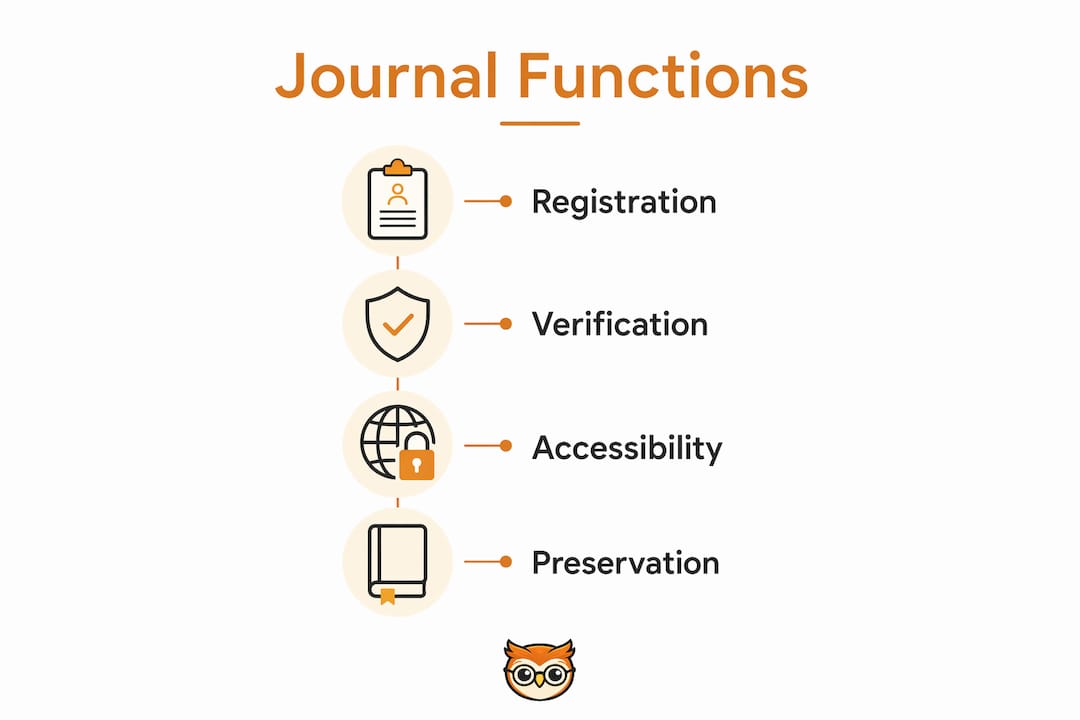
Academic journals perform four core functions: registration, verification, accessibility, and preservation. Each function addresses a distinct need in the scholarly communication ecosystem, and together they form the backbone of how knowledge moves from a researcher's desk to the global record.

Registration: claiming priority in the scholarly record
Registration is the formal act of recording that a researcher made a specific claim at a specific point in time. When a paper is accepted and published, the date of submission and publication creates a timestamped entry in the scholarly record. This matters enormously in competitive fields where two research groups may be working on the same problem simultaneously. The journal acts as the official register, settling questions of intellectual priority.
Verification: the peer review process
Peer review is the mechanism by which journals verify that research meets the standards of a discipline. Manuscripts are evaluated by independent experts before acceptance, filtering out methodological errors, unsupported claims, and misrepresented data. This process is the primary reason researchers and institutions trust journal articles over preprints or blog posts.
One critical nuance is often overlooked: not all content within a peer-reviewed journal is itself peer-reviewed. Editorials, book reviews, and commentary pieces frequently bypass the full review process. Researchers must verify the content type, not just the journal's reputation, before treating a piece as fully validated scholarship.
Pro Tip: When citing a journal article, check the submission and review history where available. Many journals now publish reviewer comments alongside accepted papers, giving you a clearer picture of the scrutiny applied.
Accessibility and preservation
Accessibility refers to how discoverable and usable research is for other scholars and the public. Journals achieve this through indexing in databases such as Web of Science, Scopus, and PubMed, which allow researchers to search across millions of records by keyword, author, or institution. Preservation ensures that scholarship remains available decades or centuries after publication, through archiving systems and digital repositories.
The table below summarises how each function operates and why it matters.
| Function | What it does | Why it matters |
|---|---|---|
| Registration | Records the date and authorship of a claim | Establishes intellectual priority |
| Verification | Peer review filters for quality and accuracy | Builds trust in published findings |
| Accessibility | Indexing and open access make research findable | Extends the reach and utility of scholarship |
| Preservation | Archiving ensures long-term availability | Protects the scholarly record for future researchers |
These four functions have historically been bundled together inside a single journal. That bundling is now coming apart, and understanding why requires looking at what technology has done to each function separately.
How have modern technologies and AI reshaped journal functions?
The shift from journals as discovery interfaces to trust layers is the defining transformation in academic publishing right now. For most of the 20th century, a researcher discovered new work by browsing journal issues or searching a database tied directly to journal content. Today, AI-powered tools handle synthesis, summarisation, and personalised recommendation at a scale no journal website can match.
This creates a structural separation. AI systems are becoming the primary interaction layer for research discovery. Journals are becoming the certification layer, the place where the validity of a finding is formally attested. Publishers who understand this shift are repositioning themselves accordingly.
The practical implications for researchers are significant:
- Discovery now happens outside the journal. Researchers encounter papers through AI tools, social networks, and preprint servers before they ever visit a journal's website.
- Synthesis is increasingly automated. AI systems can summarise a body of literature in seconds, reducing the time researchers spend reading full articles.
- Trust verification remains the journal's core value. When an AI system cites a finding, the journal's peer review record is what gives that citation weight.
- Publishers are investing in machine-readable metadata and governance frameworks to help AI systems accurately interpret and present scholarly knowledge.
- The journal article is no longer the primary unit of interaction. It is the source of record that sits behind a layer of AI-mediated discovery.
Pro Tip: When evaluating AI-generated literature summaries, always trace claims back to the original peer-reviewed source. AI tools can misrepresent findings, and the journal record is your ground truth.
Publishers are evolving from content gatekeepers into providers of trusted metadata, context, and governance. This is not a diminishment of their role. It is a reconfiguration. The journal article is no longer the job in the sense of being the end product researchers interact with daily. It is the foundation that makes the entire ecosystem trustworthy. Academics who understand this distinction will navigate the publishing landscape far more effectively than those who still think of journals purely as venues for career advancement.
The challenge for publishers is maintaining relevance when researchers rarely visit their platforms directly. Journals that invest in rich semantic tagging, open metadata, and interoperability with AI systems will retain their position as trusted infrastructure. Those that do not risk becoming invisible, even if their content remains technically accessible.
What challenges currently affect the sustainability of academic journals?
The sustainability crisis in academic publishing is real, and it operates on several levels simultaneously. Reviewer fatigue, the undervaluation of editorial labour, and the distorting effects of impact factors all threaten the quality and openness of the scholarly record.
Reviewer fatigue is the most immediate problem. The volume of manuscripts submitted to journals has grown dramatically, but the pool of qualified reviewers has not grown at the same rate. Experienced researchers are asked to review more papers than they can reasonably assess with care. The result is slower turnaround times, declining review quality, and a growing number of outright refusals. Systems like MetaROR have attempted to address the recognition gap for reviewers, but cultural change across institutions is still needed.
The "publish or perish" culture compounds this problem in a specific way:
- Researchers are pressured to publish frequently in high-impact journals to secure positions, grants, and promotions.
- This pressure incentivises submitting work before it is fully developed, increasing the burden on reviewers.
- Journals with high impact factors become gatekeepers of career progression, not just knowledge.
- Prestige becomes decoupled from actual article quality, as the journal container carries more weight than the individual contribution.
- Researchers in lower-resourced institutions or less prestigious fields face structural disadvantages in accessing these gatekeeping journals.
"The common 'publish or perish' culture leads to epistemic waste by prioritising novelty and prestige over robust, accessible scholarship. The result is a system that produces more papers but not necessarily better science."
The concept of epistemic waste is worth dwelling on. When researchers write papers primarily to satisfy career metrics rather than to advance knowledge, the scholarly record fills with incremental, duplicative, or poorly contextualised findings. Reviewers spend time on manuscripts that should not have been submitted. Readers spend time filtering noise. The entire system becomes less efficient at its core purpose.
The tension between academic rigour and societal relevance adds another layer of complexity. Journals that prioritise methodological purity can become inaccessible to practitioners who need findings they can apply. Journals that prioritise accessibility risk being dismissed by academic gatekeepers as insufficiently rigorous. Resolving this tension requires mutual recognition between scholars and practitioners, and new scholarly communication approaches that do not force a false choice between the two.
Editorial labour is the invisible cost that holds the system together. Editors, associate editors, and reviewers contribute thousands of hours of skilled work to journals, often without pay or formal recognition. The role of editors in maintaining quality is substantial, yet most institutional reward systems treat it as a minor service activity. Without structural change in how this labour is valued, the quality of peer review will continue to erode.
How do journals fit into the broader scholarly communication ecosystem?
Journals occupy a specific and increasingly well-defined position within the scholarly communication ecosystem. They are no longer the only route to dissemination, but they remain the primary route to certification. Understanding this distinction clarifies what journals are for and what they are not.
The table below maps the key actors in the modern scholarly communication ecosystem and their primary functions.
| Actor | Primary function | Relationship to journals |
|---|---|---|
| Researchers | Produce and consume knowledge | Authors and readers of journal content |
| Journals | Certify and preserve validated research | Core validation infrastructure |
| Publishers | Provide metadata, governance, and distribution | Operate and maintain journals |
| AI systems | Discover, synthesise, and recommend research | Interact with journal content as a data layer |
| Institutions | Fund research and reward publication | Depend on journal prestige for evaluation |
| Repositories | Archive and provide open access | Complement and sometimes bypass journals |
The journal as a container is distinct from the journal as a prestige brand. A researcher publishing in Nature is not just depositing a finding in a container. They are attaching a prestige signal to their work that carries weight in hiring committees, grant panels, and citation counts. Impact factors, despite their well-documented limitations, remain the dominant currency of academic reputation. This creates a situation where the publishing standards that journals enforce matter less to career progression than the journal's ranking.
Publishers are responding to the AI-driven ecosystem by investing in infrastructure rather than content alone. Rich semantic tagging, persistent identifiers such as DOIs, and open metadata standards allow AI systems to accurately attribute and contextualise findings. This is the direction in which the role of academic publishing is moving: from producing articles to maintaining the trusted data layer that AI systems draw upon.
For researchers and graduate students, the practical implication is clear. Choosing where to publish is no longer just about prestige. It is about which journals provide the metadata infrastructure, open access options, and indexing coverage that will make your work discoverable and citable in an AI-mediated research environment. Journals that invest in digital education trends and open infrastructure will carry your work further than those that rely on historical prestige alone.
Key takeaways
Academic journals remain the primary certification infrastructure in scholarly communication, even as AI systems take over discovery and synthesis functions.
| Point | Details |
|---|---|
| Four core functions | Journals register, verify, make accessible, and preserve research as a bundled service. |
| Peer review nuance | Not all journal content is peer-reviewed; always verify the content type before citing. |
| AI is reshaping discovery | AI tools now mediate how researchers find papers, making journal metadata more critical than ever. |
| Sustainability is under threat | Reviewer fatigue and publish-or-perish culture erode quality and openness across the system. |
| Prestige vs. infrastructure | Choosing journals based on metadata quality and open access is as important as impact factor. |
The trust layer that cannot be automated
The most common mistake I see academics make is treating journals as career tools rather than knowledge infrastructure. That framing is understandable given how hiring and promotion systems work, but it misses what journals actually do that nothing else can replicate.
Peer review, for all its flaws, is the only scalable mechanism we have for certifying that a finding has been scrutinised by qualified experts. AI can summarise, synthesise, and recommend. It cannot yet replicate the judgement of a domain expert reading a methodology section and identifying a confounding variable the authors missed. That judgement is what journals protect, and it is worth protecting.
The editorial labour question keeps me up at night more than the AI question does. We are asking experienced researchers to give thousands of hours to a system that gives them almost nothing in return, while simultaneously complaining that review quality is declining. The solution is not more appeals to academic duty. It is structural recognition: formal credit in promotion criteria, funded reviewer time, and institutional acknowledgement that editorial work is research work.
My advice to graduate students navigating this system is to think about journals in two registers simultaneously. Think about prestige when you must, because the system demands it. But also think about infrastructure: which journals are indexed where, which provide open metadata, which will make your work findable in five years when the discovery landscape looks nothing like it does today. The researchers who build careers on genuinely accessible, well-indexed scholarship will outlast those who chase impact factors alone.
Journals are not dying. They are becoming the foundation that everything else is built on. That is a more important role, not a lesser one.
— BibliOWLteca
Academic publishing and digital content on Bibliowlteca
Bibliowlteca supports academics and researchers who want to share knowledge beyond the traditional journal system. Whether you are distributing research-based e-books, course materials, or educational guides, the platform provides the infrastructure for global digital delivery, payment processing, and audience management.

Researchers looking to reach practitioners, students, and international audiences can list and sell academic e-books directly through Bibliowlteca's marketplace. The platform handles multiple currencies, tax compliance, and digital delivery, so you can focus on the content rather than the logistics. For academics who want to turn their expertise into accessible digital products, Bibliowlteca offers a direct route to a global audience without the gatekeeping constraints of traditional publishing.
FAQ
What is the primary role of academic journals?
Academic journals register, verify through peer review, make accessible, and preserve scholarly research. They serve as the formal certification infrastructure that distinguishes validated knowledge from unreviewed claims.
Are all articles in peer-reviewed journals peer-reviewed?
No. Content types such as editorials, book reviews, and commentary pieces often bypass the peer review process. Researchers should verify the content type of any article before treating it as fully peer-reviewed scholarship.
How is AI changing the function of journals in research?
AI systems are taking over discovery and synthesis functions, meaning researchers increasingly encounter papers through AI tools rather than journal websites. Journals are shifting toward a trust and certification role, with publishers investing in machine-readable metadata to support AI accuracy.
What is "publish or perish" and why does it matter?
"Publish or perish" describes the pressure on researchers to publish frequently in high-impact journals to advance their careers. This culture can prioritise novelty and prestige over rigour, contributing to epistemic waste and reviewer fatigue across the system.
How should researchers choose which journal to publish in?
Researchers should consider prestige, but also evaluate a journal's indexing coverage, open access options, and metadata infrastructure. Journals that invest in open, machine-readable data will make research more discoverable in an AI-driven scholarly environment.