

Most online courses fall into one of five bands: mini-courses run 1 to 2 hours, short courses 3 to 8 hours, full courses 10 to 30 hours, and semester or credential-style programmes stretch to 60 to 150 hours or more. Intensive bootcamps are compressed into a few demanding weeks. The right veebikursuse pikkus, or online course length, isn't a number you pick from a chart. It's set by what the learner needs to be able to do afterwards, and confusion usually starts when people mix up contact hours with the independent study sitting behind them.
TL;DR:
- Most courses are designed to match specific learning goals, with micro-courses lasting 1-2 hours and semester programs exceeding 60 hours.
- Clarify whether the total hours listed include scheduled contact time, independent study, or both, as providers often combine these figures without distinction.
- Weekly workload estimates range from 2 to over 9 hours, depending on course type, with lesson modules optimized at 5 to 8 lessons per week for better completion rates.
- Courses aiming for skill acquisition typically last 4 to 6 weeks, while competency-building takes 8 to 12 weeks, and certification requires 150 or more hours.
- Evaluate whether the course's time breakdown, assessment structure, and access period align with your goals and schedule before committing.
Table of Contents
- Common online course length categories explained
- What "hours" actually means when providers advertise a course
- Weekly workload: turning total hours into a realistic schedule
- Choosing course length by learning goal, not by habit
- Estonian benchmarks: how B1 exam-prep courses set the pace
- A practical checklist before you commit to a course length
- How BibliOWLteca thinks about course length
- Publish your course at whatever length actually works
- Sources
Common online course length categories explained
Course length tends to cluster around five recognisable formats, each tied to a different kind of promise.
- Mini-courses (1–2 hours): built as lead magnets or single-skill primers, often free or under $50, designed to be finished in one sitting.
- Short courses (3–8 hours): target one specific competency, such as a software feature or a writing technique, and usually fit into a weekend.
- Full short-form courses (10–30 hours): cover a broader skill area across several weeks, blending video lessons with exercises and sometimes a project.
- Semester or credential courses (60–150+ hours): combine scheduled contact time with independent study, mirroring the structure of a university module.
- Intensive bootcamps: squeeze the same total hours into a shorter calendar window, often 10 to 20 hours a week for four to eight weeks.
Course-design benchmarks put a typical paid short course at 3 to 8 hours of total content, spread across 5 to 7 modules. That's the format most creators default to, but it's far from the only workable one.
What "hours" actually means when providers advertise a course
Course listings almost always report two separate figures, and conflating them is the single biggest source of confusion for shoppers.
- Contact hours (sometimes called academic hours): scheduled time in live sessions, whether that's a Zoom class, a webinar, or a supervised lab.
- Independent study hours: the homework, reading, and practice a provider expects learners to complete alone, rarely supervised but factored into the advertised total.
- Combined totals: many providers simply add the two together. A course listing 60 contact hours plus 60 independent hours reports "120 hours" of study, which then maps onto a calendar, commonly around two months at that pace.
- Accredited or exam-prep reporting: these courses tend to be the most precise about the split, because certification bodies expect a clear breakdown of supervised versus self-directed time.
If a listing gives one number with no breakdown, ask which portion is scheduled and which is homework before assuming you know the real time cost.
Weekly workload: turning total hours into a realistic schedule
A total hour count means little until it's converted into a weekly rhythm you can actually sustain. Self-paced courses tend to ask for 2 to 5 hours a week; cohort-based programmes with live sessions and group work often run 5 to 10 hours; and instructor-led professional courses can demand 9 hours a week or more, close to the roughly 135 total hours typical of a 15-week, 3-credit university module.
Micro-structure matters just as much as the weekly total:
- Lesson videos work best between 5 and 15 minutes, long enough to teach one idea, short enough to finish on a commute.
- Modules typically hold 5 to 8 lessons, giving learners a natural weekly unit to complete.
- Releasing one module per week, rather than dumping everything at once, is linked to completion increases of 30 to 40% in some platform studies.
Pro Tip: If you're building a course, schedule the drip release before you finish filming. Knowing you have exactly six weekly slots forces tighter lessons than an open "publish whenever" timeline.
Choosing course length by learning goal, not by habit
Duration should follow the transformation you're promising, not the other way round. A course teaching one software shortcut and a course claiming to make someone job-ready need entirely different clocks. Instructional-design guidance frames this plainly: pick 4 to 6 weeks for focused skill upskilling and reserve 8 to 12 weeks for instructor-led programmes where feedback, projects, and peer interaction do real work.
A few rules of thumb help decide:
- Skill acquisition (learn one tool, one technique): 4 to 6 weeks, short course band.
- Competency or capability building (combine several skills into a working ability): 8 to 12 weeks, full course or intensive bootcamp band.
- Certification or qualification (meet an external standard): 150+ hours, semester or credential band, because the assessment itself demands sustained practice.
Longer isn't automatically better. A 12 week course teaching what a 4 week course could cover just wastes learner time and inflates dropout risk. Read more on matching course duration to learner outcomes before committing to a length.
Estonian benchmarks: how B1 exam-prep courses set the pace
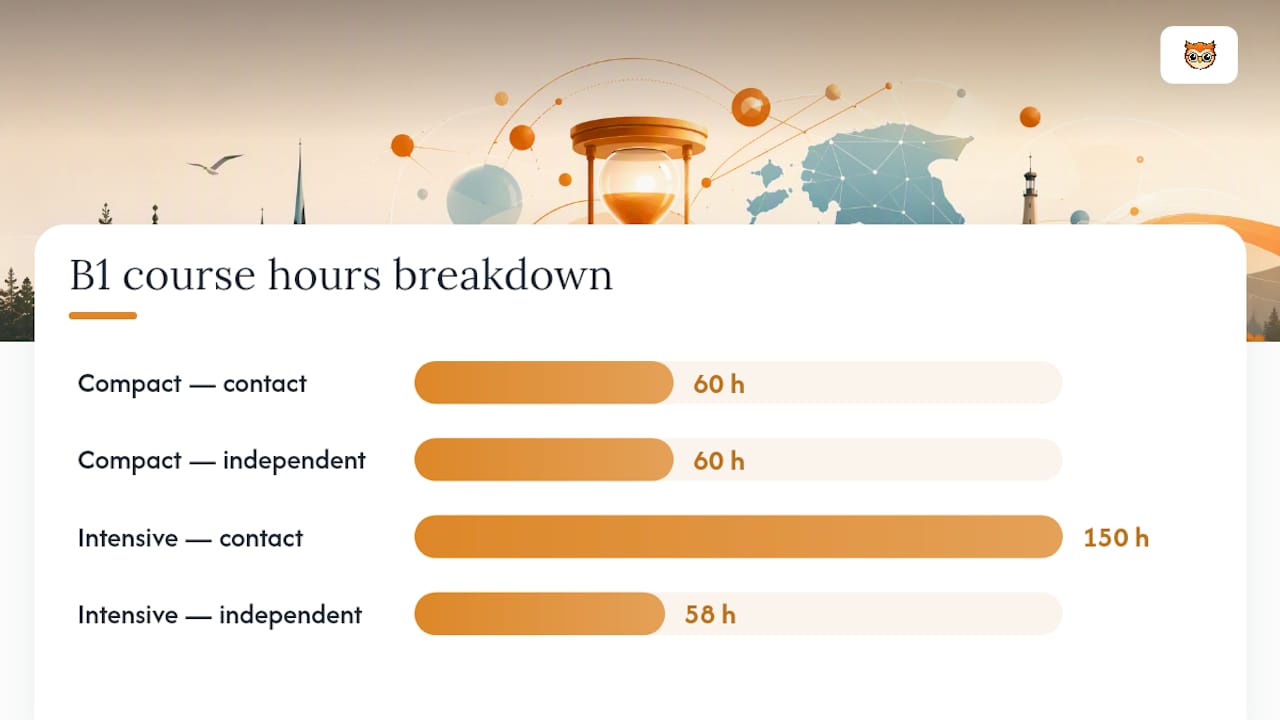
Estonian language and exam-prep providers give some of the clearest real-world examples of how these principles play out. B1-level exam-preparation courses commonly range from 60 academic contact hours plus 60 independent hours over roughly two months, up to more intensive options combining 150 academic contact hours with around 58 independent hours across roughly four months.
A few things worth noticing in how these are packaged:
- Session frequency is usually stated explicitly: some Estonian B1 courses run three sessions a week at three academic hours each, which is what turns 150 contact hours into a manageable semester.
- Providers that list 60 contact hours as a compact exam-prep package target learners with a near-term test date, not a leisurely pace.
- When a provider's page abbreviates the details, check three things before enrolling: how long you keep access after the course ends, whether mock exams or feedback sessions are included, and whether independent hours are genuinely self-directed or require submitted work.
A practical checklist before you commit to a course length
Before enrolling in, or publishing, a course of a given length, run through this short list.
- Learning outcome: does the stated goal need a skill (short), a capability (medium), or a qualification (long)?
- Hours breakdown: is the total split clearly into contact and independent study, or just a single vague figure?
- Weekly commitment: does the pace fit realistically into your week, not just your ambition?
- Assessment and feedback cadence: are there checkpoints, or is it video-and-quiz with no human input?
- Access window versus price: does a longer access period justify a higher price, or are you paying more for the same content?
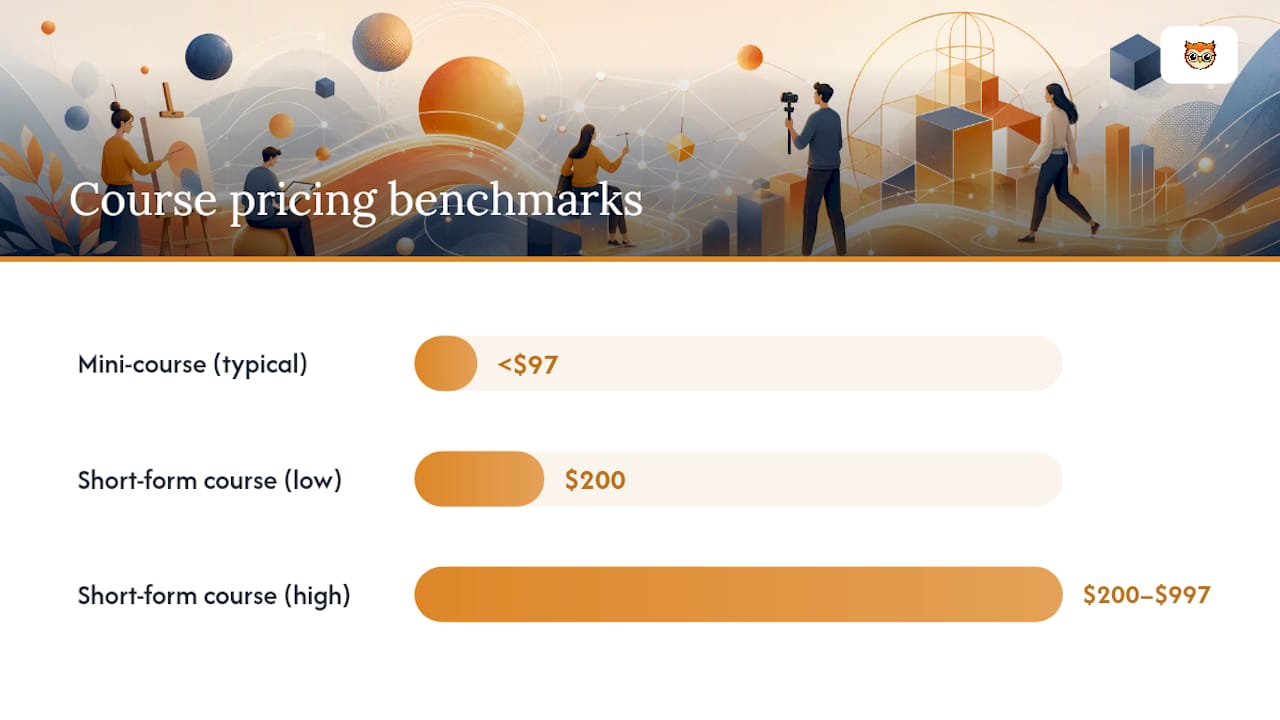
Statistic Callout: Course-length and pricing benchmarks suggest mini-courses typically sit under $97, while full short-form courses of 5 to 15 hours often support $200–$997 pricing, giving you a rough sense of whether a quoted price matches the hours on offer.
Use a simple three-tier score as you compare listings: underspecified (no hours breakdown, no assessment detail), fair (clear hours, basic feedback), or extensive (clear hours, structured feedback, defined access window). Walk away from anything that scores underspecified at a premium price.
How BibliOWLteca thinks about course length
We don't believe there's one correct veebikursuse pikkus. A mini-course that solves one problem in 90 minutes can outperform a bloated 20 hour course that never gets finished. What matters is giving creators the room to test.
That's why we'd rather see creators pilot a short module, watch completion data, and extend it only if learners are asking for more, rather than committing to a semester-length structure from day one. Drip-cadence experiments cost you a week, not a rebuild. If you're still shaping your format, our guide on self development course structures walks through matching duration to audience expectations.
— BibliOWLteca
Publish your course at whatever length actually works
Whichever length you land on, the harder problem is usually distribution, not duration. The platform gives creators a storefront that handles global payments, secure delivery, and course hosting, so courses of varying lengths can both go live on the same infrastructure.

If you're weighing where to price a course relative to its length, start with the platform product page to see how storefronts, analytics, and payment tools fit together, then check digital marketing tools for help pricing and promoting a course once its length is locked in. For a deeper look at pairing weekly workload with pricing strategy, our piece on skill development strategies for digital educators is worth a read before you set your first cohort date. Set up a storefront on Bibliowlteca and publish your first module this week.
Sources
- Vikool — Estonian B1 course
- Immisoft — Eesti keele B1-taseme veebikursus ja eksamiks ettevalmistus
- Course Coach — how long should an online course be?
- Villanova professional studies — design guidance
- JWU Online — how much time should an online course really take?