
TL;DR:
- An annotated bibliography pairs each research source citation with a concise evaluation and summary of the source. It demonstrates critical engagement and helps readers assess source relevance and credibility. Building annotations as you research results in more accurate, meaningful entries that enhance academic writing.
An annotated bibliography is defined as a list of research sources where each full citation is followed by a concise paragraph that summarises and evaluates the source. Unlike a standard reference list, it adds critical commentary to every entry. Annotations typically run 100–300 words, with 150 words being the most common target. That brevity forces you to be selective, which is precisely the point. Common citation styles used in annotated bibliographies include APA, MLA, and Chicago, and the format you follow depends entirely on your institution or assignment brief.
What is an annotated bibliography and why does it matter?
An annotated bibliography does two jobs at once: it documents your sources and it demonstrates that you have read and thought critically about each one. A plain bibliography tells a reader what you consulted. An annotated bibliography tells them why it matters and whether it holds up under scrutiny.
Annotations help readers judge each source's relevance, accuracy, and usefulness in academic work. That is not a minor addition. It transforms a list of titles into a map of your thinking. For a supervisor reviewing your research proposal, or a peer checking your literature review, the annotations reveal the quality of your source selection before they read a single word of your argument.
The difference between a bibliography and an annotated bibliography is therefore not just length. It is depth of engagement. A standard bibliography records sources. An annotated bibliography interrogates them. That distinction matters enormously in postgraduate work, where demonstrating critical reading is as important as the argument itself.
What should you include in each annotation?
Effective annotations incorporate three moves: a statement of the source's central claim, a brief overview of its evidence or method, and one clear quality judgement. Each move earns its place. Together they fit comfortably within a 150-word paragraph without padding.
The three core elements break down as follows:
- Summary of the central argument. State what the source argues or reports. One to two sentences is enough. Avoid quoting directly; paraphrase to show you have processed the content.
- Evidence or method overview. Note how the author supports the argument. Is it a meta-analysis, a case study, a theoretical framework, or primary archival research? This tells the reader how much weight the source can carry.
- Evaluation of credibility and usefulness. Judge the source against your research question. Is the author an authority in the field? Are there notable limitations, such as a small sample size or a dated publication year? Does the source support, challenge, or add nuance to your argument?
Some assignments ask for a fourth element: a reflection on how the source fits into your broader project. This is sometimes called a relevance statement, and it is the most personal part of the annotation. It answers the question "so what does this mean for my research?"
Pro Tip: Write the summary and evaluation in separate sentences rather than blending them. Blended sentences tend to obscure your critical judgement, which is often what your marker is looking for.
Annotation length varies by assignment type. A summary-only annotation might run to 75 words. A fully evaluative annotation for a doctoral literature review can reach 300 words. When in doubt, check the assignment brief before you start drafting, not after.
What types of annotated bibliographies are there?
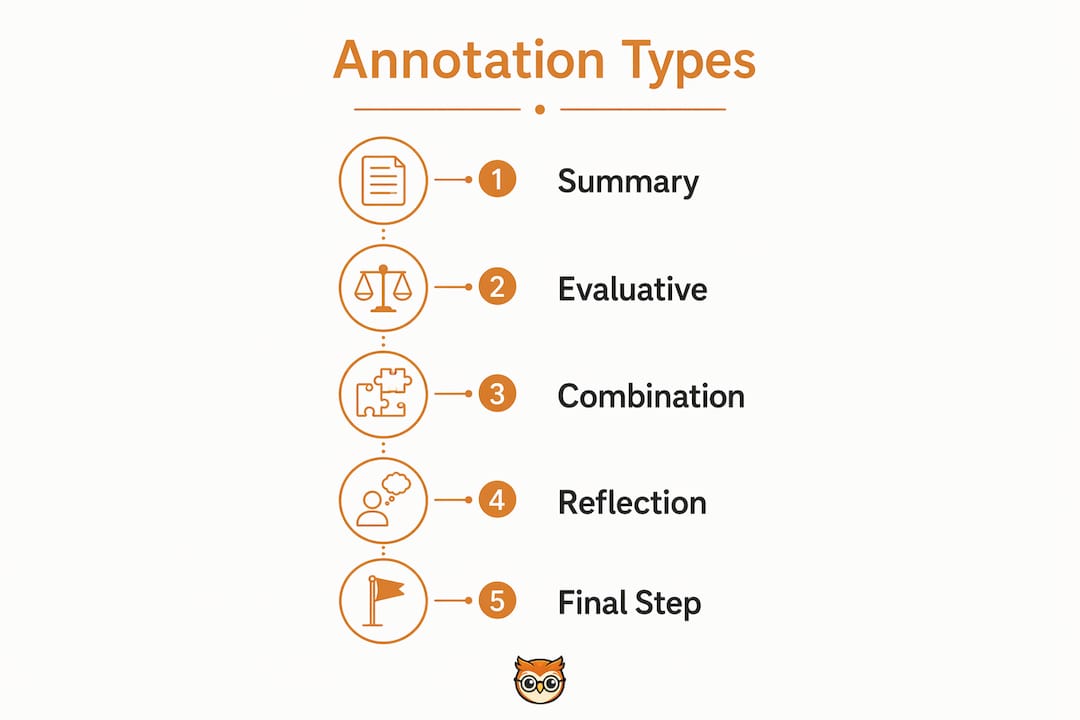
Three major annotation types exist: summary, evaluative, and combination. The type you produce depends on what your assignment requires, not on personal preference.
| Type | Focus | Typical use |
|---|---|---|
| Summary annotation | Describes the source's content and main arguments only | Introductory courses, preliminary reading lists |
| Evaluative annotation | Assesses credibility, strengths, and limitations alongside content | Research proposals, postgraduate work |
| Combination annotation | Summarises and evaluates, then reflects on relevance to the project | Dissertations, literature reviews, funded research |
The summary annotation is the most straightforward. It answers "what does this source say?" without passing judgement. Undergraduate students often encounter this type first, particularly in introductory research methods modules.
The evaluative annotation goes further. It asks "how reliable is this source and what are its weaknesses?" A history student annotating a primary source might note that the author's political position introduces bias. A science student might flag that a study's sample was too small to generalise. This critical layer is what separates a competent annotation from an excellent one.
The combination annotation is the most demanding and the most useful. It summarises, evaluates, and then explicitly states how the source advances or contrasts with the research topic. For a dissertation, this type is almost always required, even when the brief does not spell it out. Aligning your annotation style with the assignment requirements is not optional. Submitting a summary-only annotation when an evaluative one is expected will cost you marks, regardless of how well written it is.
How to create an annotated bibliography step by step
Building an annotated bibliography is a process, not a single task. Breaking it into clear stages prevents the common mistake of trying to write citations and annotations simultaneously, which leads to errors in both.
-
Read the assignment brief carefully. Identify the required citation style (APA, MLA, or Chicago), the annotation type, the word limit per annotation, and the total number of sources required. These four details govern every decision that follows.
-
Select credible and relevant sources. Peer-reviewed journal articles, academic monographs, and authoritative reports are the standard. Use your institution's library databases rather than general web searches. A practical guide on evaluating sources can help you apply the CRAAP test (Currency, Relevance, Authority, Accuracy, Purpose) or similar frameworks to each candidate source.
-
Read actively and take notes. Do not annotate from memory. As you read, note the central argument, the key evidence, and any limitations you spot. A close reading workflow helps you extract exactly what you need without rereading entire texts later.
-
Format the citation first, then write the annotation. The two-layer approach of perfecting your citation before drafting the annotation reduces errors and saves time. Citation errors are easy to overlook when you are focused on prose. Getting the reference right first means you can concentrate fully on the annotation.
-
Draft the annotation in three sentences. Sentence one: the central claim. Sentence two: the evidence or method. Sentence three: your quality judgement. Add a fourth sentence for relevance if the assignment requires it. This structure keeps annotations consistent across all entries.
-
Proofread for citation accuracy and annotation consistency. Check that every citation follows the correct style guide rules. Verify that author names, publication years, volume numbers, and page ranges are accurate. Read all annotations together to confirm they are consistent in tone, length, and level of critical engagement.
Pro Tip: Write a "so what?" sentence/14%3A_The_Research_Process/14.15%3A_Creating_an_Annotated_Bibliography) for each source before you draft the full annotation. This one sentence forces you to articulate why the source matters to your specific research question, which makes the rest of the annotation much easier to write.
A common mistake is treating the annotated bibliography as a task to complete at the end of a project. The most effective researchers build it as they go, adding and revising entries throughout the research process. This approach means the bibliography reflects your evolving understanding of the field rather than a rushed summary written under deadline pressure.
What are the most common challenges in writing annotations?
The single most frequent problem in student annotations is description without evaluation. A student writes two sentences summarising what a book argues, then stops. A good annotation is not just descriptive but also evaluative, helping readers judge source reliability. Description alone tells a reader nothing they could not learn from the abstract.
A second challenge is length control. Students either write too little, producing a single vague sentence, or too much, turning the annotation into a mini essay. Annotations are concise paragraphs limited to the essentials of source evaluation. They do not follow traditional essay structure and do not include in-text citations within the annotation itself.
Common pitfalls to watch for:
- Copying from the abstract. Abstracts are written by the author to promote the work. Your annotation should reflect your independent reading and judgement.
- Ignoring limitations. Noting only strengths makes an annotation look uncritical. Every source has weaknesses worth naming.
- Inconsistent tone. Switching between formal academic prose and casual commentary within the same bibliography looks unprofessional.
- Mismatched citation style. A single incorrectly formatted citation undermines the credibility of the entire document.
"Annotations demonstrate careful reading and critical engagement, showing understanding of central ideas and academic value. The common misconception is treating annotations as mere notes instead of thoughtful evaluation of source credibility and contributions."
The fix for most of these problems is the same: write the annotation immediately after reading the source, while your impressions are fresh. Waiting until you have read all sources means annotations become blurred and generic. Specificity is what makes an annotation genuinely useful.
Key takeaways
An annotated bibliography is defined by two inseparable parts: a correctly formatted citation and a concise, evaluative annotation that demonstrates critical engagement with the source.
| Point | Details |
|---|---|
| Definition is precise | An annotated bibliography pairs each citation with a 100–300 word evaluative paragraph, not just a summary. |
| Three annotation types exist | Summary, evaluative, and combination annotations serve different academic purposes and assignment requirements. |
| Format citation before annotating | Completing the citation first reduces errors and lets you focus fully on the annotation's critical content. |
| The "so what?" sentence is essential | One sentence connecting the source to your research question sharpens every annotation and saves drafting time. |
| Evaluation beats description | Annotations that only summarise miss the point; credibility judgements are what markers and readers need most. |
Why annotations changed how I think about research
Most students treat the annotated bibliography as a bureaucratic hurdle. I used to think the same. After working with hundreds of researchers and educators through Bibliowlteca, I have come to see it differently. The annotation process is where real research thinking happens.
When you are forced to write 150 words on a single source, you cannot hide behind vague impressions. You have to decide whether the author's argument actually holds, whether the methodology is sound, and whether the source genuinely advances your project. That discipline transfers directly into stronger literature reviews, sharper thesis statements, and more confident academic writing overall.
The misconception I see most often is that annotations are a record of what you read. They are not. They are a record of what you thought about what you read. That shift in framing changes everything. Students who understand this produce annotations that read like intellectual contributions rather than reading logs.
My practical advice: treat each annotation as a conversation with a future version of yourself who has forgotten why you chose this source. Write it clearly enough that you could return six months later and immediately understand the source's value and its limitations. That standard produces annotations worth reading.
— BibliOWLteca
Build your research library with Bibliowlteca
Annotated bibliographies depend on access to quality sources. Bibliowlteca's digital marketplace brings together academic ebooks, research guides, and educational content from creators worldwide, all available for instant download.

Whether you are a student building your first bibliography or an educator curating a reading list for a course, the platform gives you access to a broad catalogue of academic materials across disciplines. Bibliowlteca supports multiple currencies and international payments, so researchers anywhere can access the content they need. Browse the ebook catalogue to find peer-reviewed and expert-authored resources that strengthen your annotated bibliography from the first source you select.
FAQ
What is the difference between a bibliography and an annotated bibliography?
A bibliography lists sources used in research. An annotated bibliography adds a concise evaluative paragraph after each citation, explaining the source's content, credibility, and relevance to the research topic.
How long should each annotation be?
Annotations typically run 100–300 words, with 150 words being the most common target. The exact length depends on the assignment brief and the annotation type required.
What citation styles are used in annotated bibliographies?
APA, MLA, and Chicago are the three most common citation styles. The style you use is determined by your institution, discipline, or assignment instructions.
Do I need to evaluate sources or just summarise them?
Evaluation is required for most academic annotated bibliographies. A summary-only annotation is acceptable for some introductory assignments, but evaluative and combination annotations are the standard expectation at undergraduate and postgraduate level.
Can I write annotations as I research rather than at the end?
Writing annotations immediately after reading each source produces stronger, more specific entries. Waiting until all sources are read leads to blurred impressions and generic annotations that lack critical depth.