

TL;DR:
- Authorship ethics involves fairly assigning credit and responsibility based on genuine contributions. It emphasizes principles of recognition, accountability, and transparency to maintain research integrity.
Authorship ethics is the practice of assigning credit and responsibility for creative and scholarly works based on clear, fair, and transparent principles. For writers, educators, and content creators, understanding what is authorship ethics means grasping how recognition, accountability, and honesty shape the integrity of every published work. Recognised standards such as the ICMJE recommendations and the 2026 National Academies framework set the benchmark for ethical authorship guidelines across disciplines. Getting this right protects your reputation, supports fair collaboration, and builds the trust your audience places in your work.
What is authorship ethics and why does it matter?
Authorship ethics is defined as the set of principles governing who receives credit for a work, who bears responsibility for its integrity, and how those decisions are communicated transparently. The term overlaps with the broader concept of publication ethics, which covers the full lifecycle of responsible scholarly and creative publishing. Both terms are used throughout this article, as they describe the same core obligations from different angles.

The importance of authorship ethics reaches well beyond academic journals. Ghost authorship, honorary credits, and undisclosed contributions damage credibility in every publishing context, from peer-reviewed research to self-published e-books and online courses. When credit is misassigned, readers cannot trust the expertise behind the work. Funders and institutions lose confidence in the outputs they support.
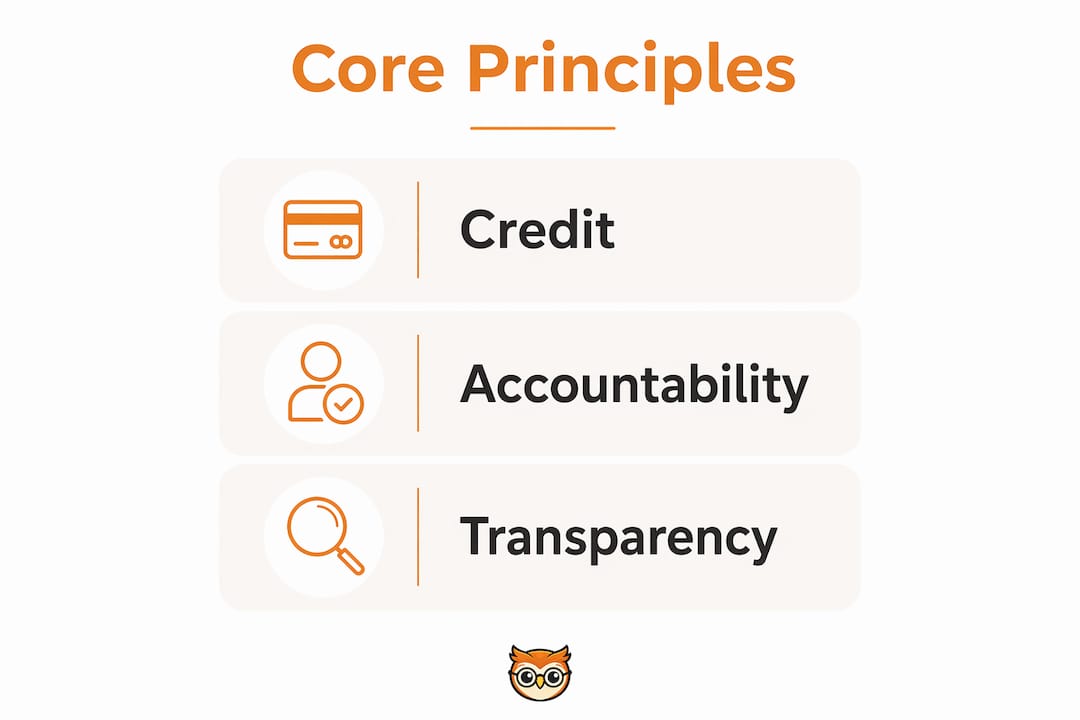
Responsible authorship is anchored in three principles: credit, accountability, and transparency. The 2026 framework emphasises harmonising variable authorship guidelines to strengthen research integrity in interdisciplinary work. That harmonisation matters because writers and educators increasingly collaborate across fields, institutions, and national borders.
What are the core principles of authorship ethics?
Three interconnected principles define what constitutes ethical authorship: credit, accountability, and transparency. Each one addresses a distinct failure mode that arises when authorship is handled carelessly.
Credit: recognising real contributions
Credit means giving rightful recognition to everyone who made a substantial intellectual contribution to a work. Substantial means more than providing data, funding, or administrative support. It means shaping the ideas, methods, analysis, or writing in a meaningful way. Listing someone as an author because of their seniority or institutional position, without genuine contribution, is a direct violation of this principle.
Accountability: owning the whole work
Accountability for the entire work is a critical but frequently overlooked authorship criterion. Every listed author must be able to stand behind the full work, not only the section they personally wrote. This transforms honorary authorship from a harmless favour into a genuine liability. If a paper is retracted for data fabrication, every named author shares the professional consequences.
Transparency: making roles visible
Transparency requires clear disclosure of what each author actually did. Contribution statements, now standard in many journals, list each author's specific role, whether that is conceptualisation, data collection, writing, or review. Transparent contribution statements enable readers to understand author roles and promote accountability. They also make it far harder to hide ghost or honorary authorship.
These three principles work together. Credit without accountability produces vanity listings. Accountability without transparency produces confusion about who is responsible for what. Transparency without credit produces invisible contributors whose work goes unrecognised.
- Credit requires that authorship reflects genuine intellectual contribution, not status or convenience.
- Accountability requires that every author accepts responsibility for the integrity of the entire work.
- Transparency requires that contribution statements clearly describe each author's role.
- Collective responsibility requires that institutions, journals, and funders reinforce these principles through policy and practice.
Pro Tip: Draft a contribution statement at the start of any collaborative project, not at the end. Updating it as the project evolves prevents disputes and keeps everyone aligned on who has done what.
How do leading authorship guidelines shape ethical practice?
The ICMJE sets four criteria that a contributor must meet to qualify as an author. These criteria are the most widely adopted standard in academic and scientific publishing.
- Substantial contributions to the conception, design, data acquisition, or analysis of the work.
- Drafting or critically revising the work for important intellectual content.
- Final approval of the version to be published.
- Accountability for all aspects of the work, including the ability to identify and resolve questions about accuracy or integrity.
A contributor must meet all four criteria to qualify as an author under ICMJE. Meeting only one or two criteria earns acknowledgement, not authorship. This distinction matters enormously in practice.
The 2026 framework from the National Academies builds on ICMJE by calling for harmonised standards across disciplines. Different fields have historically applied different authorship norms. In some scientific fields, laboratory heads are routinely listed as authors regardless of contribution. In the humanities, sole authorship remains the norm. Harmonisation aims to reduce these inconsistencies and create a shared baseline for publishing in academia.
What roles do not qualify for authorship?
The following roles contribute to a project but do not meet the threshold for authorship under ICMJE guidelines:
| Role | Appropriate recognition |
|---|---|
| Funding provider | Acknowledgements section |
| Routine technical support | Acknowledgements section |
| Data collection only | Acknowledgements or contributor note |
| Proofreading or copyediting | Acknowledgements section |
| Departmental supervision without intellectual input | Acknowledgements section |
These contributors deserve recognition. They do not deserve authorship credit they have not earned, because authorship carries accountability obligations they have not accepted.
AI tools and authorship
AI tools like ChatGPT cannot be listed as authors because they lack the legal capacity for accountability and cannot give or withhold consent. Current consensus across major journals and institutions excludes AI from authorship entirely. Any use of AI in drafting, analysis, or image generation must be disclosed in the methods or acknowledgements section. The human authors remain fully accountable for all AI-assisted content.
What are common ethical challenges and how do you avoid them?
Ghost authorship and honorary authorship are the two most prevalent forms of authorship misconduct. Both seriously threaten academic credibility and carry real consequences for career advancement, funding eligibility, and institutional reputation.
Ghost authorship occurs when someone who made a substantial contribution is deliberately omitted from the author list. This happens most often when a professional writer drafts a manuscript on behalf of a researcher or when a junior contributor's work is absorbed without credit. Ghost authorship conceals the true origin of ideas and methods, which misleads readers and reviewers.
Honorary authorship, also called gift authorship, occurs when someone is listed as an author without meeting the contribution criteria. Senior academics, department heads, or funding bodies are the most common recipients of unearned authorship. The risk is real: failing accountability standards makes honorary authorship a liability rather than a benefit. If the work is later questioned, every named author is implicated.
Authorship disputes arise most often from a lack of early, written agreements about who will contribute what. As projects evolve, contributions shift. A researcher who was central at the design stage may disengage. A new collaborator may join mid-project and make substantial contributions. Without documented records, these changes create conflict at the point of submission.
Practical steps to avoid these problems:
- Agree on authorship criteria at the project's outset, before any writing begins.
- Document each contributor's role in writing and update the record as the project develops.
- Use a recognised framework such as the CRediT (Contributor Roles Taxonomy) to categorise contributions clearly.
- Raise concerns about authorship early, not at the submission stage when pressure is highest.
- Involve all contributors in reviewing the final author list before submission.
Pro Tip: If a dispute arises, refer to your institution's research integrity office or the journal's editorial guidelines. Most journals have formal processes for handling authorship disagreements, and using them is far less damaging than allowing a dispute to become public.
How can you implement ethical authorship in practice?
Ethical authorship is not a passive standard. It requires active decisions at every stage of a project, from initial planning through to publication and beyond.
Start the conversation early
The single most effective step is discussing authorship before any work begins. Agree on who will contribute, in what capacity, and what threshold of contribution earns authorship credit. This conversation is uncomfortable in hierarchical settings, but avoiding it creates far greater discomfort later. Authorship decisions require early-stage explicit agreements and regularly updated records to avoid disputes during publication.
Use contribution statements as standard practice
Contribution statements are no longer optional in responsible publishing. Many journals now require them, and readers increasingly expect them. A clear statement listing each author's specific role, written in plain language, signals that the authorship has been handled with care. It also gives every contributor visible credit for their actual work, which matters for career development and grant applications.
Maintain documented records
Keep a living document that tracks each contributor's involvement throughout the project. Update it after major milestones: after the first draft, after data collection, after peer review revisions. Authorship disputes often arise from lack of early, updated written agreements reflecting evolving project contributions. A documented record resolves most disputes before they escalate.
Recognise collective responsibility
Authorship culture requires collective responsibility from researchers, journals, funders, and institutions. Individual writers and educators cannot carry this alone. Institutions must train early-career researchers in authorship ethics. Journals must enforce contribution statements and audit authorship claims. Funders must require transparency in the outputs they support. When all parties act on their responsibilities, the culture shifts.
The table below shows how responsibility is distributed across the key actors in any publishing project:
| Actor | Core responsibility |
|---|---|
| Individual authors | Agree on contributions early; maintain records; disclose AI use |
| Institutions | Train researchers; enforce integrity policies; support dispute resolution |
| Journals and editors | Require contribution statements; audit authorship claims; act on complaints |
| Funders | Mandate transparency in funded outputs; support open access and attribution |
The role of editors in enforcing these standards is particularly significant. Editors are the last line of defence before a work reaches readers, and their decisions about authorship compliance shape the norms of an entire field.
Key takeaways
Ethical authorship is defined by three principles: credit, accountability, and transparency, all of which require active, documented practice from every contributor and institution involved in a work.
| Point | Details |
|---|---|
| Three core principles | Credit, accountability, and transparency together define what constitutes ethical authorship. |
| ICMJE four-criteria standard | All four ICMJE criteria must be met for authorship; partial contribution earns acknowledgement only. |
| AI cannot be an author | AI tools must be disclosed in methods or acknowledgements; human authors remain fully accountable. |
| Early agreements prevent disputes | Documenting contributions from the project's outset is the most effective way to avoid authorship conflicts. |
| Collective responsibility | Institutions, journals, funders, and individual authors all share responsibility for ethical authorship culture. |
Authorship ethics is harder than it looks
Bibliowlteca works with writers and educators across many disciplines, and the pattern is consistent: most authorship problems are not caused by bad intentions. They are caused by conversations that never happened. A senior researcher assumes their name belongs on a paper because they run the lab. A junior collaborator assumes they will be credited because they did most of the writing. Neither assumption is stated aloud, and the gap between them becomes a dispute at the worst possible moment.
The 2026 push toward harmonised authorship standards is welcome, but standards alone do not change behaviour. What changes behaviour is a culture where asking "who is an author and why?" is treated as a normal, professional question rather than an accusation. Bibliowlteca believes that education is the foundation of that culture. Writers and educators who understand the principles of authorship ethics are far better placed to model responsible practice for the people they work with and teach.
The uncomfortable truth is that honorary authorship persists largely because challenging it feels socially risky. Junior researchers fear damaging relationships with supervisors. Collaborators avoid confrontation to protect future opportunities. The solution is not to make people braver. It is to make the norms so clear and so widely understood that unethical authorship becomes the socially awkward choice, not the challenge to it.
— BibliOWLteca
Publishing your work ethically with Bibliowlteca
Writers and educators who take authorship ethics seriously deserve a publishing platform that supports that commitment.

Bibliowlteca gives creators the tools to publish e-books, courses, and digital products with full control over attribution, distribution, and audience. Every product you publish carries your name and your standards. The platform handles payments, tax compliance, and global delivery, so you can focus on the quality and integrity of your content. Whether you are sharing original research, teaching publication ethics, or building a digital course on responsible writing, explore Bibliowlteca's features to see how the platform supports transparent, credible knowledge sharing. You can also browse the full range of educational e-books available to deepen your understanding of publishing ethics and best practice.
FAQ
What is authorship ethics in simple terms?
Authorship ethics is the practice of giving credit and assigning responsibility for a published work fairly and transparently, based on genuine contribution rather than status or convenience.
What are the ICMJE criteria for authorship?
The ICMJE requires four criteria: substantial contribution to the work, drafting or critically revising it, final approval of the published version, and accountability for the entire work's integrity.
Can AI tools be listed as authors?
No. AI tools such as ChatGPT cannot be listed as authors because they lack the legal capacity for accountability and cannot give consent. Their use must be disclosed in the methods or acknowledgements section.
What is the difference between ghost and honorary authorship?
Ghost authorship omits a genuine contributor from the author list. Honorary authorship adds someone who did not meet the contribution criteria. Both are forms of authorship misconduct that undermine credibility and accountability.
How do you prevent authorship disputes?
Agree on authorship criteria in writing at the start of a project, document each contributor's role, and update those records as the work evolves. Most disputes arise from the absence of early, explicit agreements.