
The quickest route to institutional ebook sales is not a cold email to a librarian. It is procurement readiness: clean metadata, a territorial licence offer, and a marketplace listing that institutions can actually buy from. Prepare your ISBN, register with Public Lending Right, flag your territorial rights clearly, and list on a platform that supports institutional licensing such as Bibliowlteca. Bodies such as Jisc, NWUPC, and SUPC are the gatekeepers for most UK higher education purchasing, and appearing on their approved supplier lists removes the single biggest friction point in the sales cycle.
Key takeaways
Procurement readiness, clean metadata, and an accessible EPUB are the three non-negotiable prerequisites for institutional ebook sales in the UK.
| Point | Details |
|---|---|
| Procurement frameworks first | Register with Jisc/CHEST, NWUPC, or SUPC before approaching institutions directly. |
| Metadata drives discoverability | ISBN, BISAC codes, territorial rights, and a MARC record are required for library catalogue integration. |
| Licence options close deals | Offer at least two models (site licence and concurrent user) to match different institutional budgets. |
| Accessibility is a procurement criterion | WCAG 2.1 AA compliance and a tagged EPUB are checked before purchase at most UK universities. |
| Bibliowlteca supports the full workflow | The platform handles institutional licence listings, metadata exports, and multi-currency invoicing in one place. |
Table of Contents
- What should you do in the first 90 days to prepare?
- How do UK procurement frameworks work, and why do they matter?
- What licensing models do institutions actually expect?
- What metadata and legal declarations do institutions need?
- Which UK distribution routes should you use?
- What technical and accessibility standards do institutions require?
- How do you sell to librarians and build credibility?
- How do invoicing, PLR, and ongoing reporting work?
- Your 30-point institutional launch checklist
- Why marketplace readiness matters more than most creators realise
- Bibliowlteca makes institutional ebook sales practical
- Sources
What should you do in the first 90 days to prepare?
The goal is to move from "I have an ebook" to "an institution can buy it without raising a procurement query." That requires three short sprints.
Days 0–30: foundations
- Assign an ISBN to every title and register it with Nielsen Book Services.
- Complete Cataloguing in Publication (CIP) data with the British Library.
- Register with PLR UK so digital loans feed into your royalty reporting.
- Open a marketplace account (Bibliowlteca supports institutional licence options from the outset).
- Confirm territorial rights in writing: UK, EU, world English, or world.
Days 30–60: documentation
- Draft a licence template covering scope, territory, access model, user limits, and DRM terms.
- Produce a sample MARC record and a KBART file for your catalogue.
- Run an accessibility audit against WCAG 2.1 AA: tagged headings, alt text, logical reading order.
- Write a one-page sell sheet with CIP data, curriculum fit, and pricing.
Days 60–90: routes to market
- Research which procurement framework fits your product (Jisc/CHEST for HE, NWUPC or SUPC for regional consortia, Crown Commercial Service for public libraries).
- Begin wholesaler or aggregator onboarding (Gardners, IngramSpark, or a specialist digital aggregator).
- Compile a supplier capability statement and two reference contacts for framework applications.
Pro Tip: Metadata and rights clarity are the two things procurement teams check first. A title with a missing territorial flag or an ambiguous licence scope will stall at the purchase order stage regardless of how good the content is.
How do UK procurement frameworks work, and why do they matter?
A procurement framework is a pre-negotiated agreement between a buying consortium and a set of approved suppliers. When a university or public body wants to buy software or digital content, using a framework means they skip the full tender process, which can take months. For you as a supplier, being on the list means a buyer can issue a purchase order the same week they decide to buy.
Jisc's CHEST agreements let suppliers offer software and online resources to universities and colleges under pre-agreed licence terms, cutting procurement friction to near zero. NWUPC's Software Licences Reseller framework provides a compliant route for HE and public sector organisations to purchase from pre-approved suppliers across the North West and beyond. SUPC covers the South, and similar regional consortia exist across Scotland and Wales.
The UK public procurement portal records framework lots that specify licence types, SaaS delivery models, and software asset management services. Reading live framework notices gives you the exact language buyers use, which is invaluable when drafting your own application. Intermediaries such as Jisc Collections also provide licence templates that reduce the need for bespoke legal contracts, which is a significant advantage for small publishers without in-house legal resource.
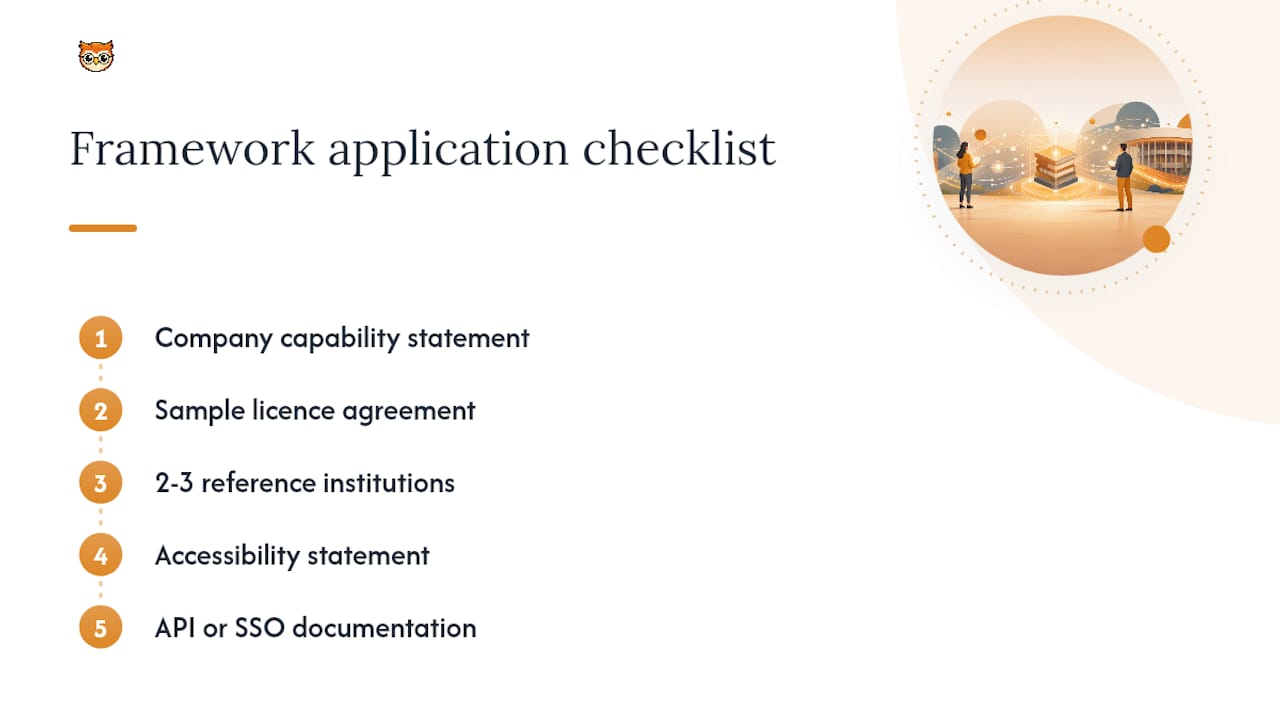
To apply, prepare: a company capability statement, a sample licence agreement, two or three reference institutions, an accessibility statement, and basic API or SSO documentation if your platform supports it.
What licensing models do institutions actually expect?
Libraries and procurement teams are not looking for a single price point. They want options that fit their budget cycles and usage patterns. The most common models are:
- Perpetual access — a one-off payment for permanent access to a defined version. Popular with academic libraries that need archival certainty.
- Site licence (annual subscription) — flat fee for all users at one institution. Simple to administer and easy to renew.
- Concurrent user licence — a set number of simultaneous users. Cost-effective for titles with moderate demand.
- Course or cohort licence — priced per enrolled student for a defined teaching period. Preferred by course teams buying for a specific module.
- Pay-per-loan — the institution pays per download or loan event. Low commitment, useful for pilot phases.
For pricing shapes, consider flat annual fees banded by FTE (full-time equivalent student count), per-course cohort pricing, or a tiered model that scales from a single-site licence to a multi-campus agreement. Avoid pricing that requires a librarian to calculate anything complex: the simpler the invoice, the faster the purchase order.
A short licence template should cover: scope of use, territory, access model, maximum concurrent users, reporting obligations, DRM terms, and archival rights. Selling digital educational products requires careful attention to territorial rights and pricing; institutions will not proceed without these declared upfront.
What metadata and legal declarations do institutions need?
Procurement and cataloguing teams work from metadata. If yours is incomplete, your title simply does not appear in their discovery systems.
| Field | Requirement | Notes |
|---|---|---|
| ISBN | Mandatory | One per format (print, EPUB, PDF) |
| Title and subtitle | Full, exact | Match the cover exactly |
| Publisher name | Registered publisher | As listed with Nielsen |
| BISAC subject codes | Minimum two | Primary and secondary subject |
| Publication date | YYYY-MM-DD | ISO date format |
| Territorial rights | Explicit flags | UK, EU, World English, World |
| Licence type | Named model | Perpetual, subscription, concurrent |
| Accessibility statement | WCAG 2.1 AA | Linked or embedded |
| PLR registration number | UK PLR | Required for digital loan reporting |
Beyond the metadata fields, publishing standards matter for institutional discoverability. Deliver a MARC 21 record for library catalogue import and a KBART file for knowledge base systems such as ExLibris Alma or OCLC WorldShare. Both are straightforward exports if your metadata is clean from the start.
On the legal side: include clear VAT treatment on invoices (standard-rated digital services for UK B2B), a one-line GDPR note confirming you process only the data needed for licence administration, and your PLR registration details so institutions can report digital loans accurately.
Which UK distribution routes should you use?
The route you choose depends on whether you need catalogue reach, procurement ease, or margin control.
Wholesalers (Gardners, Bertrams) sit between publishers and library buyers. They handle physical and digital supply, manage discount structures, and are trusted by procurement teams. Gardners' onboarding documents outline requirements for ISBN registration, discount bands, consignment handling, and invoicing. Use this route when you want your title in library management systems automatically.
Aggregators and digital distributors (IngramSpark for print-and-digital, specialist digital aggregators for ebook-only) feed titles into academic discovery platforms. Library distribution routes for independent publishers typically use IngramSpark for print and aggregators for ebook distribution. One critical warning: KDP Select exclusivity blocks library distribution entirely, so avoid it if institutional sales are a priority.
Direct marketplace listings (Bibliowlteca) give you full control over pricing, licence terms, and buyer relationships. This route suits creators who want to offer bespoke institutional licences, trial access, or cohort pricing without a wholesaler taking a margin cut.
Most small publishers use a combination: a wholesaler for catalogue reach and a direct marketplace listing for negotiated institutional deals.
What technical and accessibility standards do institutions require?
Institutions will not integrate a title they cannot authenticate or that fails accessibility checks. The baseline requirements are:
- File formats: EPUB 3 (reflowable preferred; fixed-layout only where the content demands it), PDF as a secondary format, ISBN-linked filenames.
- Authentication: SSO via SAML 2.0 or LTI 1.3 for VLE integration; IP-range access as a fallback; OAuth 2.0 for API access.
- Analytics: COUNTER 5-compliant usage reports; institutions expect monthly or quarterly data on title-level access.
- DRM: choose between social DRM (watermarking) for frictionless access or Adobe DRM for stricter licence control. Social DRM is increasingly preferred by academic libraries because it reduces user friction without eliminating licence enforcement.
- KBART and MARC exports: required for knowledge base and catalogue integration.
Pro Tip: The fastest accessibility fix is running your EPUB through the free EPUB Accessibility Checker before submission. Missing alt text and untagged headings account for the majority of failures, and both take under an hour to correct.
The role of ebooks in education extends beyond content delivery: accessible formats directly affect whether a title can be adopted for a course with disabled students, which is a procurement criterion at most UK universities.
How do you sell to librarians and build credibility?
Academic library buyers prioritise curricular fit, authoritative content, and clear licensing and accessibility documentation. Salesmanship here is about trust and integration, not features.
Your one-page sell sheet should include: title and author, subject and BISAC codes, curriculum fit statement (which modules or courses does this support?), licence options with indicative pricing, accessibility compliance level, and a contact for trial access. Keep it to a single A4 page. Librarians receive dozens of these; brevity is a competitive advantage.
Offer a time-bound trial: 30 days, full access, with COUNTER-compliant usage data delivered at the end. That data gives the librarian evidence to justify the purchase to their acquisitions committee. Structure the trial with clear terms: no automatic renewal, no data retained after expiry, and a named contact for technical queries.
Red flags that kill deals: unclear territorial rights, missing MARC records, inaccessible EPUB files, and licence terms that require legal review. Fix these before your first approach, not after.
How do invoicing, PLR, and ongoing reporting work?
Public sector buyers operate on purchase order numbers and extended payment terms. Expect 30-day terms as a minimum; 60 or 90 days end-of-month is common in higher education. Never invoice without a PO number: it will not be paid.
For PLR, register every eligible title at PLR UK. Digital loans from public libraries feed into PLR calculations where the lending library participates in the digital PLR scheme. Keep records of which institutions hold licences and in which format, as this data supports your PLR submissions.
Operational reporting cadence:
- Monthly: COUNTER 5 usage reports to each institutional customer.
- Quarterly: KBART file updates if your catalogue changes.
- Annually: licence renewal notices sent 90 days before expiry, with updated pricing if applicable.
- On request: MARC record updates, accessibility statement revisions, and amended licence terms.
Consignment arrangements with wholesalers require separate reconciliation: Gardners and similar wholesalers invoice on a sale-or-return basis, so track stock and returns separately from direct institutional invoices.
Your 30-point institutional launch checklist
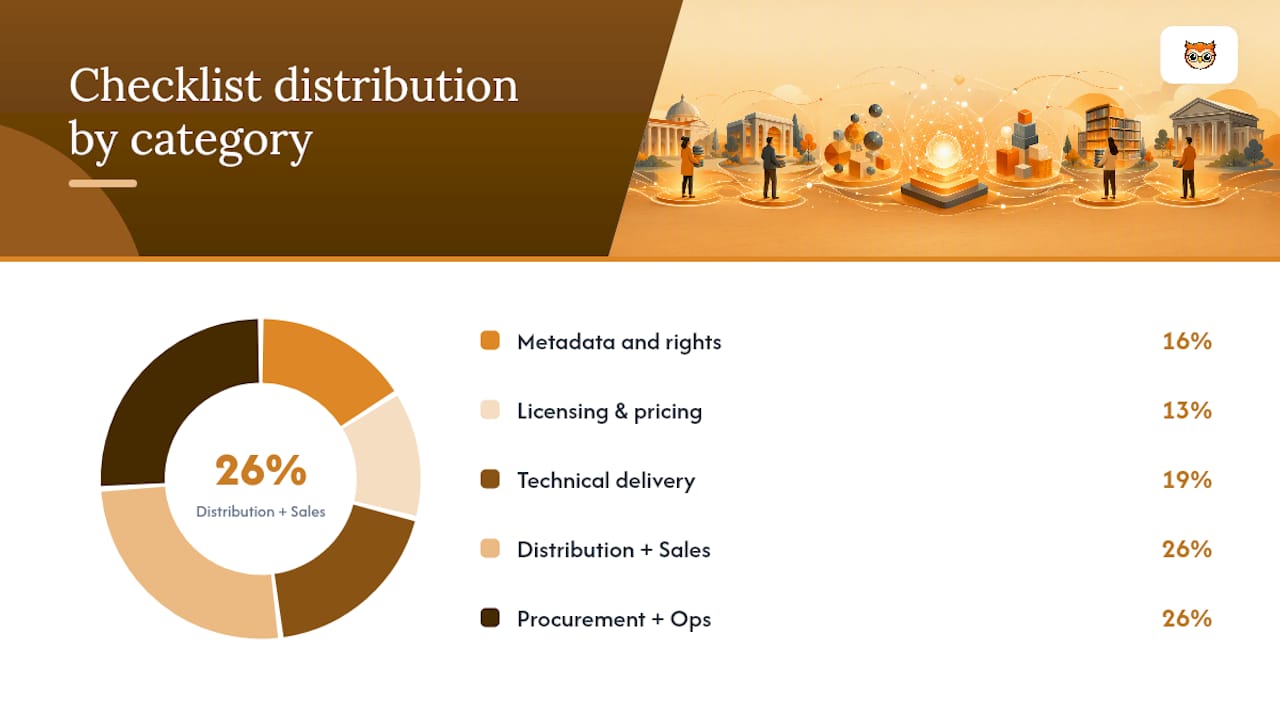
Work through these before approaching any institution or framework:
Metadata and rights
- ISBN assigned (per format)
- CIP completed with the British Library
- BISAC codes assigned (minimum two)
- Territorial rights declared in writing
- PLR registration confirmed
Licensing and pricing
- Licence template drafted (scope, territory, access model, user limits, DRM, archival)
- At least two pricing models available (e.g. site licence and concurrent user)
- VAT treatment confirmed with HMRC or your accountant
- GDPR data processing note prepared
Technical delivery
- EPUB 3 file passes accessibility checker
- Alt text and heading tags complete
- COUNTER 5 reporting configured
- KBART file generated
- MARC 21 record prepared
- SSO or IP-range authentication documented
Distribution
- Wholesaler account opened (Gardners or equivalent)
- Aggregator or direct marketplace listing live (Bibliowlteca)
- KDP Select exclusivity avoided or ended
- Metadata feed submitted to distributor
Sales materials
- One-page sell sheet complete
- Trial access terms documented
- Reference institution or case study identified
- Accessibility statement published
Procurement
- Framework research completed (Jisc/CHEST, NWUPC, SUPC)
- Capability statement drafted
- Framework application submitted or scheduled
- Supplier quick reference document prepared
Operations
- Invoicing template with PO number field ready
- Payment terms set (30/60/90 day EOM)
- Reporting calendar set up
- Renewal notice workflow in place
Pro Tip: Identify one pilot institution before you apply to any framework. A single reference customer with documented usage data is worth more than any capability statement when a procurement panel evaluates your application.
Why marketplace readiness matters more than most creators realise
Most creators focus on content quality and assume the sales will follow. The institutional market does not work that way. A university library cannot buy a title that lacks a MARC record, just as a procurement officer cannot issue a PO to a supplier not on an approved list. The paperwork is not bureaucracy for its own sake: it is the mechanism by which institutions protect public money and ensure the content they buy is accessible to all students, including those with disabilities.
Getting framework-ready and maintaining clean metadata accelerated procurement opportunities for publishers who invested in it early. The library trends shaping digital education in 2026 point consistently toward institutions consolidating suppliers onto fewer, better-documented frameworks. That means the window for new entrants is narrowing: the publishers who build procurement infrastructure now will be harder to displace later.
Bibliowlteca's platform supports institutional licence options, metadata management, and the documentation workflows that make framework applications credible. The combination of a direct marketplace listing and a framework registration is, in practice, the most efficient route to a sustainable institutional revenue stream.
Bibliowlteca makes institutional ebook sales practical
Getting your ebook in front of library acquisition teams requires more than a good title. It requires licence documentation, metadata exports, accessibility compliance, and a checkout process institutions can actually use. Bibliowlteca is built for exactly this: creators list ebooks with institutional licence options, manage MARC and KBART exports, and handle multi-currency invoicing from a single platform.
The platform reduces procurement friction by providing sample licence templates, technical integration documentation for SSO and API access, and PLR reporting support. For small publishers without a dedicated rights team, that infrastructure is the difference between a title that sits on a personal website and one that appears in a university library catalogue.
List your first institutional ebook on Bibliowlteca and have your procurement documentation ready before your first library conversation.
Sources
The sources below are worth bookmarking before you begin any framework application or wholesaler onboarding:
- Software Vendors
- Notice 048814-2026
- Software licences reseller & consulting services (NWUPC)
- Gardners CPI onboarding documents
- 5 Tips for Authors Who Want to Get Their Books into Libraries | Writers & Artists
- Publishing