
TL;DR:
- Knowledge creators transform expertise into lasting digital educational content focused on impact.
- Success depends on skills in production, platform use, audience building, and business management.
- Genuine impact and credibility are more valuable than viral metrics for long-term growth.
Not every online creator is chasing viral moments or trying to land brand deals. A growing segment is doing something far more enduring: turning hard-won expertise into structured knowledge that changes how people think, work, and learn. These are knowledge creators, and they operate in a fundamentally different way from entertainers. With the global creator economy now worth hundreds of billions of pounds and expanding rapidly, the space for expert-driven education has never been larger. This article explains who knowledge creators truly are, what skills and platforms they need, how they monetise their expertise, and how they measure genuine impact, so you can chart a clear path forward.
Table of Contents
- Who are knowledge creators and what makes them different?
- Core skills and platforms: What knowledge creators need to succeed
- How knowledge creators monetise expertise: Products, models, and earning mechanics
- Measuring impact and standing out: The real markers of success for knowledge creators
- Why real expertise, not algorithms, is the future for knowledge creators
- Unlock your potential with BibliOWLteca
- Frequently asked questions
Key Takeaways
| Point | Details |
|---|---|
| Knowledge creators defined | They specialise in sharing expertise and building educational products, not just entertaining. |
| Essential skills | Success requires content creation ability, platform know-how, audience-building, and business acumen. |
| Monetisation strategies | Selling courses, communities, and IP means multiple income streams and global reach. |
| Lasting success markers | Real impact comes from educational outcomes, cultural relevance, and credibility in the field. |
Who are knowledge creators and what makes them different?
The term gets thrown around loosely, but it has a precise meaning. A knowledge creator is someone who takes deep subject-matter expertise and transforms it into valuable digital experiences: courses, frameworks, books, research-backed guides, or community-led learning programmes. This stands in sharp contrast to entertainers, lifestyle influencers, or reaction-video creators whose primary goal is engagement rather than understanding.
The clearest way to see the distinction is through intent. An entertainer succeeds when you laugh, scroll, or share. A knowledge creator succeeds when you learn something actionable and your real-world outcomes improve. That shift in purpose changes everything, from the products they build to the audiences they attract and the longevity of their work.
What makes knowledge creators particularly powerful right now is what some analysts call the credibility economy. As AI-generated content floods the internet with plausible-sounding but often shallow or inaccurate information, audiences are actively seeking verified human expertise. Credentials, lived experience, original research, and genuine track records have become more valuable, not less. Knowledge creators sit squarely at the centre of this shift.
They also think in terms of international reach and long-term value. A well-structured course or e-book written today can educate learners in Singapore, São Paulo, and Stockholm for years to come. Entertainment trends fade within weeks. A trusted educational framework compounds in value over time.
Here is how knowledge creators compare to other creator types:
| Characteristic | Knowledge creator | Entertainment creator |
|---|---|---|
| Primary goal | Educate and drive outcomes | Entertain and engage |
| Core product | Courses, books, frameworks | Videos, performances, reels |
| Success metric | Learner outcomes, citations | Views, likes, shares |
| Content lifespan | Years (evergreen) | Days to weeks |
| Revenue model | Sales, memberships, licensing | Ads, sponsorships, merch |
Knowledge creators typically share several defining traits:
- They build authority around a specific subject area rather than a broad personal brand
- They produce content that holds up under scrutiny and can be cited or referenced
- They invest in structured delivery: syllabi, modules, workbooks, and frameworks
- They attract learners who are motivated to change their behaviour or outcomes
- They can access marketplaces for expert content that connect them with global audiences
"Knowledge creators are educators, authors, and entrepreneurs who share expertise and drive measurable impact. They are fundamentally distinct from entertainers."
This distinction matters enormously if you are deciding how to position yourself. Building a knowledge-focused brand requires a different strategy, a different content calendar, and a different mindset than chasing trending topics.
Core skills and platforms: What knowledge creators need to succeed
Understanding who knowledge creators are is only the beginning. The practical question is: what does it actually take to succeed? Successful creators need a blend of production skills, platform knowledge, audience-building strategies, and business acumen to sustainably monetise their expertise. Think of these as four pillars, and weakness in any one of them will limit your growth.
Content production is the foundation. This means being able to record clear instructional video, write authoritative long-form content, design readable materials, and structure complex ideas so that a newcomer can follow them without being lost. Good production does not require expensive equipment; it requires clear thinking and an understanding of how people actually learn.

Platform proficiency is about knowing which tools serve your goals. Course platforms, e-book marketplaces, podcast hosts, and webinar tools each have their own strengths. Choosing the right combination for your content type is a strategic decision, not just a technical one.
Audience building is where many experts stumble. Having deep knowledge is not the same as having an audience. You need to understand content distribution, community management, email list growth, and how to sustain engagement between product launches.
Business acumen ties everything together. Pricing, tax compliance, international payments, licensing agreements, and customer retention are all business skills that knowledge creators must develop or outsource. Resources like digital publishing essentials can accelerate this learning curve significantly.
Here is a comparison of popular platforms for knowledge creators in 2026:
| Platform type | Best for | Limitations |
|---|---|---|
| Course platforms | Video-led structured learning | Revenue share, limited branding |
| E-book marketplaces | Written expertise, passive income | Discoverability competition |
| Own website/store | Full control, direct revenue | Requires marketing effort |
| Community platforms | Recurring engagement | Needs active moderation |
| Podcast hosts | Audio thought leadership | Slower monetisation curve |
If you are just starting out, here is a practical sequence to follow:
- Define your niche precisely. The narrower your focus, the faster you build authority.
- Choose one content format to master first: video, written, or audio.
- Build an email list from day one. Social platforms can shift their algorithms overnight.
- Create one flagship product before expanding your catalogue.
- Study your learner's results. Their outcomes are your best marketing.
- Explore tools like top e-book tools that simplify production and distribution.
Pro Tip: Resist the urge to be on every platform simultaneously. Pick two channels, go deep, and only expand once you have a repeatable system. Spreading yourself thin is the number one reason talented experts fail to build sustainable knowledge businesses.
How knowledge creators monetise expertise: Products, models, and earning mechanics
With the right skills and platforms in place, the next step is understanding how to turn your expertise into reliable income. There are more options than most creators realise, and the most successful knowledge creators do not rely on a single revenue stream.
Here are the primary monetisation models available today:
- Direct product sales: Online courses, e-books, templates, and toolkits sold once at a fixed price. This is the most accessible starting point and generates immediate cash flow.
- Membership and subscription models: Monthly or annual fees for access to ongoing content, community, or coaching. This builds predictable, recurring revenue.
- Licensing and white-labelling: Selling the rights to your frameworks or curriculum to organisations, other educators, or companies. This is often the highest-value model per unit of effort.
- Live sessions and workshops: Webinars, masterclasses, and group coaching programmes. These carry premium pricing and build strong learner relationships.
- Affiliate and partnership income: Recommending complementary products or tools your audience genuinely needs, earning commission on resulting sales.
Owning your intellectual property (IP) is critical. A framework you develop, a methodology you name, or a body of research you compile is an asset that can be licensed, taught, and sold in multiple formats over many years. This is very different from creating content that lives on a third-party platform and could disappear if policies change.
Building a community around your expertise adds another layer of value. When your learners connect with each other, share results, and help one another apply your teaching, the community itself becomes a retention and recruitment engine. You stop competing on price and start competing on belonging.
Expanding your global digital sales strategies early also multiplies your income ceiling. Digital products have no geographic limits. An educator in Manchester can serve learners in Mumbai, Mexico City, and Melbourne simultaneously, provided their platform handles multi-currency payments and international tax compliance.
Pro Tip: Diversify across at least three income streams before you consider yourself financially stable as a knowledge creator. A single course, a membership tier, and a licensing deal creates a resilient income structure that can weather changes in any one channel. You can explore how to structure this through selling e-books and courses to international audiences.
While there are over 50 million content creators globally, only a small minority build sustainable, knowledge-based incomes. The difference is almost always found in how deliberately they approach monetisation, not in how talented they are.
Measuring impact and standing out: The real markers of success for knowledge creators
Monetisation is only one side of the equation. True success as a knowledge creator is measured in impact, and impact looks very different from follower counts or view numbers.
The most meaningful indicators include:
- Learner outcomes: Did your students change their behaviour, land a new role, launch a business, or solve a persistent problem? These are the results that drive word-of-mouth referrals.
- Citation and reference: Are practitioners, other educators, or publications referencing your work? Being cited is a powerful signal of credibility.
- Influence on practice: Has your framework or methodology been adopted by organisations or communities beyond your direct audience?
- Return learner rate: Are people coming back for more of your content, or buying multiple products? Loyalty is a metric that follower count cannot capture.
Here is a practical breakdown of impact indicators and their significance:
| Impact indicator | What it signals | Why it matters long-term |
|---|---|---|
| Learner outcome data | Teaching effectiveness | Drives testimonials and referrals |
| Third-party citations | Credibility and authority | Unlocks licensing and partnership opportunities |
| International reach | Cultural relevance | Expands addressable market |
| Community engagement | Loyalty and retention | Reduces reliance on paid acquisition |
| Media mentions | Public authority | Attracts premium clients and collaborators |
Cultural relevance deserves special attention. A knowledge creator who frames their expertise in ways that resonate across cultures, languages, and professional contexts will always have a larger total audience than one who speaks only to their immediate local market. Content that translates well internationally, whether literally or conceptually, is a genuine competitive advantage.
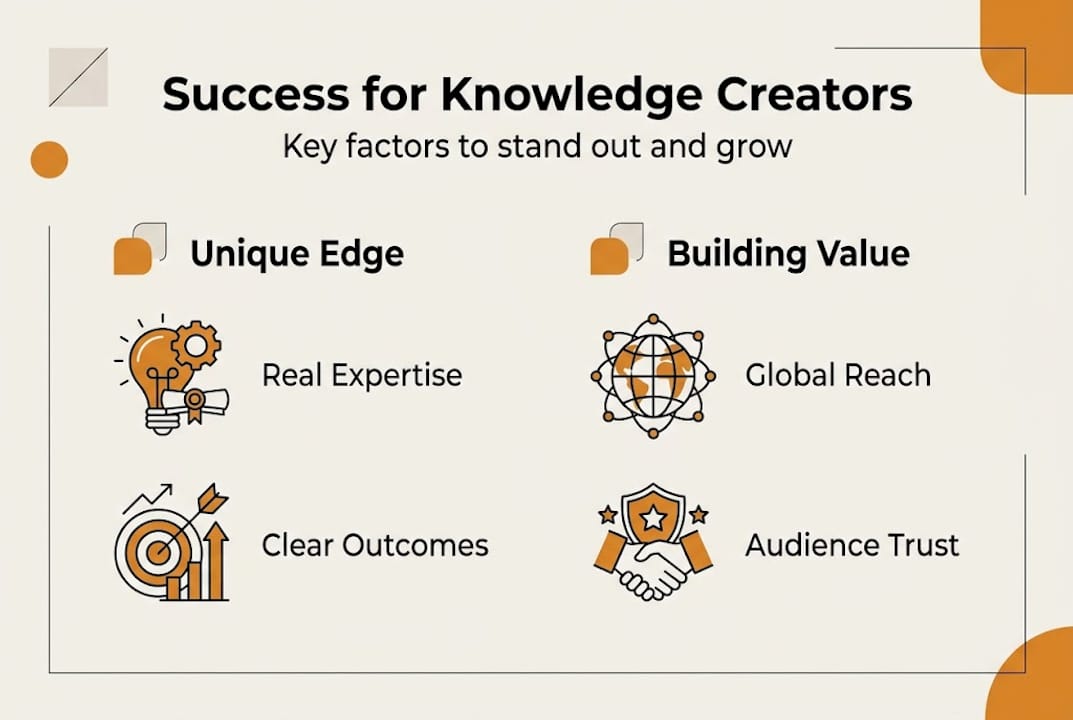
Standing out in a crowded space requires three things. First, a unique teaching angle: not just what you teach, but how you frame it in a way only you can. Second, approachable authority: being expert enough to be trusted but human enough to be followed. Third, owning your narrative: top knowledge creators are selected and recognised based on impact, cultural relevance, and genuine influence rather than raw follower numbers, with very few reaching beyond 10 million followers.
For deeper inspiration on raising your educational credibility, explore how to improve educational impact and keep an eye on 2026 education trends shaping how learners choose and consume knowledge.
"The knowledge creators who endure are not the loudest voices. They are the most trusted ones."
Why real expertise, not algorithms, is the future for knowledge creators
Here is an uncomfortable truth that most creator economy articles will not tell you: the algorithm does not care about you. It cares about engagement. And for a while, that distinction did not matter much. But we are entering a period where the gap between algorithmic popularity and genuine expertise is becoming impossible to ignore.
AI tools can now generate passable content on almost any topic in seconds. This is not a threat to knowledge creators; it is their greatest opportunity. As credibility becomes the differentiator in a sea of AI-generated noise, the educator who can demonstrate real results, cite original experience, and be held accountable for their claims becomes exponentially more valuable.
The next decade will not reward the creators who posted most consistently. It will reward those who built genuine reputational capital: people who were cited, whose frameworks were adopted, whose learners achieved real outcomes. That kind of authority cannot be faked or generated. It has to be earned.
This is why we believe knowledge creators must invest in owned assets above all else. Your email list, your intellectual property, your community, and your published body of work are yours regardless of what any platform decides tomorrow. Those who build on rented land will always be vulnerable. Those earning in the credibility economy by owning their expertise and distribution will compound their advantage year after year.
Chase depth. Build proof. Grow slowly and on your own terms. That is the path that lasts.
Unlock your potential with BibliOWLteca
If you are ready to move from sharing ideas to building a real digital business around your expertise, the infrastructure you choose matters enormously.
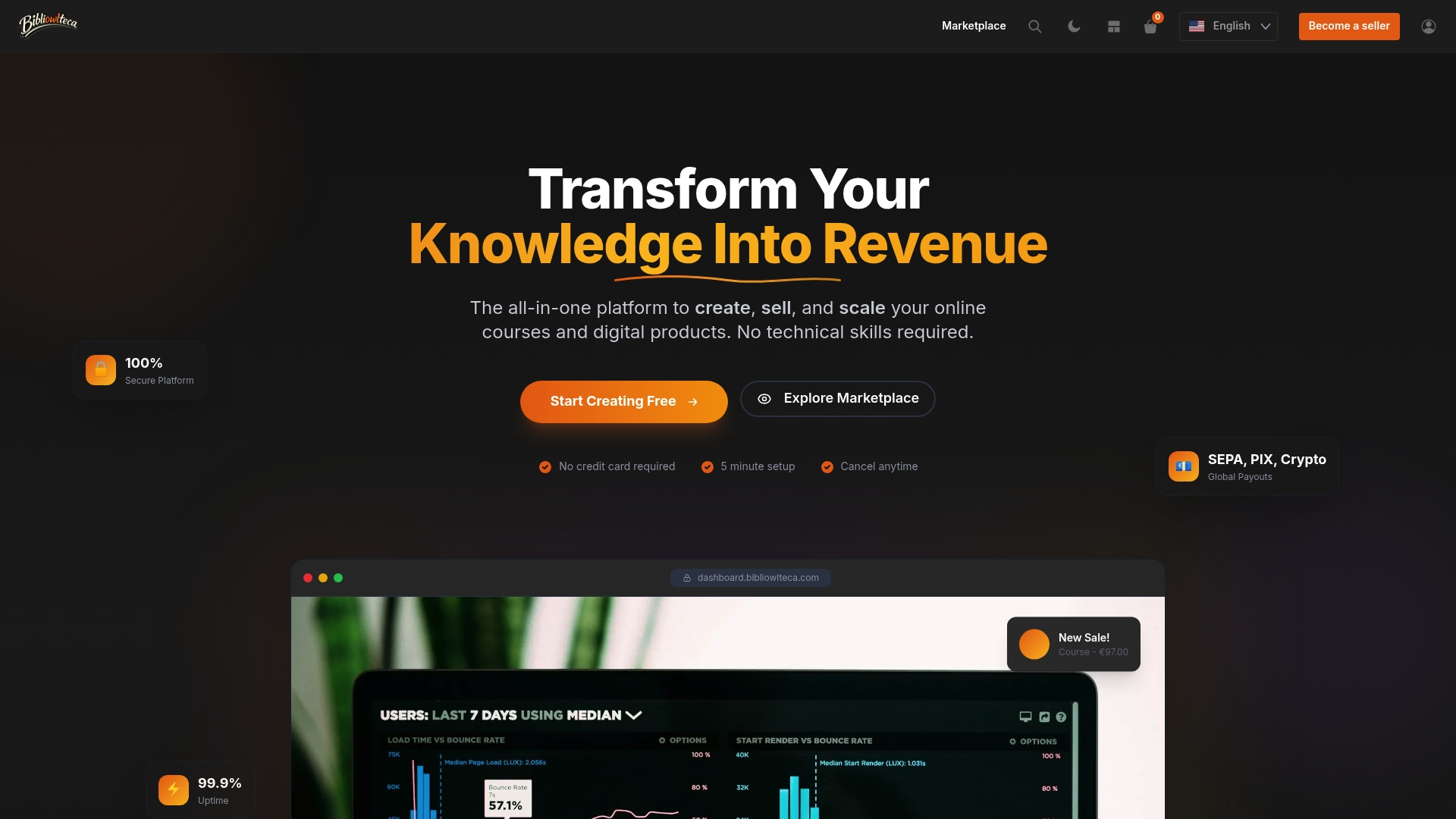
BibliOWLteca is built specifically for educators, authors, and entrepreneurs who want to sell digital content to a global audience without the usual technical headaches. From publishing e-books and courses to managing international payments and tax compliance, the platform handles the operational complexity so you can focus on creating. Whether you are launching your first product or scaling an existing catalogue, discover BibliOWLteca and see how straightforward it can be to turn your knowledge into a thriving digital business that reaches learners wherever they are in the world.
Frequently asked questions
What is a knowledge creator?
A knowledge creator is an educator, author, or entrepreneur who turns expertise into digital products such as courses, books, or frameworks, with a focus on impact and credible information rather than entertainment.
How can I make money as a knowledge creator?
You can earn by selling courses and products built on your expertise, offering memberships, licensing your frameworks to organisations, or creating communities around your specialised knowledge.
Which platforms work best for knowledge creators?
Platforms that support creation, sale, and distribution of digital content work best, including course platforms, e-book marketplaces, and dedicated educational sites, particularly those with built-in business tools for audience building and monetisation.
What is the difference between an entertainer and a knowledge creator?
Entertainers focus on amusement or performance, while knowledge creators focus on sharing verified expertise and driving measurable learning outcomes for their audiences.