

Platform fees for creators are every charge between a customer's payment and your payout: the platform's share, card processing, currency conversion and sometimes a monthly subscription. The number on the pricing page is rarely the number that matters. What matters is what lands in your account after a $20 e-book sale or a $99 course sale, and whether you owe anything in the months when nobody buys. At BibliOWLteca there is no monthly fee: we charge per completed sale, from €0.99, so your costs follow your revenue.
TL;DR
- A platform fee usually has up to four layers: the platform's cut, a fixed per-sale fee, card or wallet processing, and currency or international surcharges. Some platforms bundle them, others stack them.
- Fixed fees hurt most on cheap products. A $0.50 charge is 10% of a $5 template and half a percent of a $99 course.
- On a $20 card sale, published calculators show creators keeping anywhere from $14.00 to $19.12, depending on how the fee is built.
- A pay-per-sale model with no monthly fee means a quiet month costs you nothing. That is how BibliOWLteca is set up.
- Fees are not the only cost: check payouts, tax handling and international payment methods before you choose where to sell.
Table of Contents
- What platform fees for creators actually include
- A worked example: what you keep from a $20 sale
- Why fixed fees decide your pricing
- Subscription vs pay-per-sale: which risk do you carry?
- Membership platforms: fees that change after you launch
- Beyond the percentage: the costs hiding in the checkout
- A checklist for reading any fee page
- Perspective: what we think creators should demand from fees
- Sell on a model that follows your revenue
- FAQ
- Sources
What platform fees for creators actually include
If you sell e-books, courses, templates or coaching programmes online, the money leaves your sale in layers. Knowing the layers lets you compare any two pricing pages on equal terms.
1. The platform fee. This is the platform's share for hosting your store, delivering the file or course, and often bringing buyers. It comes as a percentage of each sale, as a flat monthly subscription, or as both.
2. A fixed per-transaction fee. A set amount on every order, such as $0.30 or $0.50. It looks small but acts like a minimum price floor on low-priced items.
3. Payment processing. The cost of moving money from the buyer's card or wallet to you. In the US, a typical domestic online card rate is around 2.9% plus $0.30. Some platforms include this in their headline fee, while others charge it separately on top. According to one 2026 comparison, a platform with a flat 5% + $0.50 all-in fee already includes processing, while others list the platform share and card processing as two separate charges.
4. International and currency surcharges. Cards issued outside the US and currency conversion usually cost more. The same comparison notes that sellers with many overseas buyers should run those surcharges separately rather than assume the domestic card rate.
5. Monthly or annual subscriptions. Some platforms charge a recurring fee for access to features, whether or not you sell anything. This is the layer that most changes your risk when you are starting out.
6. Payouts and app-store commissions. Withdrawal fees, payout delays and, for memberships bought through a mobile app, a store commission can sit on top. These rarely appear in the headline rate.
When you read a fee page, write down each layer for your own product, your own price and your own buyer mix. Two platforms with the same headline percentage can leave you with very different amounts.
A worked example: what you keep from a $20 sale
The clearest way to compare is one product at one price. A 2026 fee calculator that runs a $20 US card sale through several common fee structures gives these take-home amounts, by its own calculation:
| Fee structure | You keep on $20 | Share of the sale |
|---|---|---|
| Stripped-down payment processing only (2.9% + $0.30) | $19.12 | 95.6% |
| All-in platform fee (5% + $0.50, processing included) | $18.50 | 92.5% |
| Marketplace with listing, transaction and processing fees | $17.65 | 88.3% |
| Platform share of 10% + $0.50, with card processing on top | $16.62 | 83.1% |
| Discovery marketplace taking 30% | $14.00 | 70.0% |
The spread between the first and last rows is $5.12 on a single $20 sale. Over 500 sales that is $2,560, enough to pay for a lot of marketing.
Notice what the table shows. The cheapest structure is not a full platform at all: it is just a payment processor, and you would have to build the store, delivery, tax handling and everything else yourself. The 30% row is not a bad deal by definition. It buys access to shoppers who are already browsing. The question is whether those sales would have reached you anyway. A second comparison makes the same point: it recommends judging platforms by sales per month, not by fee percentage alone.
Why fixed fees decide your pricing
Percentages scale with your price. Fixed fees do not. That is why the same platform can feel cheap for a $149 course and expensive for a $5 checklist.
Take a $0.50 fixed fee plus a $0.30 processing fixed fee. That is $0.80 before any percentage:
- On a $5 template: $0.80 is 16% of the sale, before the percentage layers.
- On a $20 e-book: $0.80 is 4%.
- On a $99 course: $0.80 is under 1%.
One analysis of digital product pricing makes this exact point: a $0.30 or $0.50 charge is a noticeable share of a $5 download but a small share of a $99 course, so anyone pricing very cheap products should count the fixed fee first.
Two practical consequences follow.
Bundle low-priced items. Selling three $5 templates as one $12 pack pays the fixed fees once instead of three times, and often raises the average order. If you sell several related products, our guide to course bundle pricing shows how to structure a bundle discount without wiping out your margin.
Set prices after you know the fee, not before. Many creators pick a price, then discover what the fee did to it. Reverse it: decide the amount you need to keep per sale, add the fees, and set the price from there. Our course pricing strategy guide walks through that logic for courses.
The same reasoning applies if you give away or heavily discount low-cost material. A related guide on cutting academic book costs shows how per-transaction charges shape what readers and authors each end up paying for inexpensive resources.
Subscription vs pay-per-sale: which risk do you carry?
There are two broad ways platforms charge creators, and they put the risk in different places.
Subscription-led platforms charge a monthly fee, sometimes with lower percentage cuts at higher tiers. The maths works well once you are selling steadily: a larger monthly bill spread across many sales. It works poorly before you have a proven product, because the fee is due whether or not anything sells.
Pay-per-sale platforms charge nothing until an order completes. Your costs rise only when your revenue does. This is the better fit for authors with a first e-book, coaches testing a programme, experts building an audience, and anyone whose income is seasonal or uneven.
A simple test: add up twelve months of subscription fees and divide by the sales you realistically expect. If a $29 monthly plan costs you $348 a year and you expect 40 sales, that is $8.70 of fixed cost on every sale before any percentage. That figure is an assumption for illustration; plug in your own.

BibliOWLteca takes the second route. Our model charges a fee on each completed sale, from €0.99, and no monthly fee. If you are comparing models, our overview of top course platforms for monetising expertise globally sets out the types side by side, and a separate guide helps you choose the best learning platform for creators.
Membership platforms: fees that change after you launch
If you sell memberships or subscriptions, fee terms deserve more attention, because you earn from the same customer for months or years. A change in the platform's cut compounds.
Membership platforms have moved their fee schedules several times in recent years, sometimes with different rates for creators who joined before and after a certain date. Whenever you rely on one for recurring revenue, check three things on its official fee page: the percentage that applies to your account, whether processing is charged on top, and what happens if purchases are made through a mobile app, where a store commission can apply.
Recurring billing also brings regulation. The US Federal Trade Commission has been revising its rules on subscription cancellation, known as the Negative Option Rule, so any recurring product should make signing up and cancelling equally easy. Review the FTC's current guidance on its website before you launch a membership.
For course creators whose income comes mainly from one-off purchases, this volatility matters less. A per-sale fee you can read on a single page is easier to plan around than a schedule that depends on when your account was created.
Beyond the percentage: the costs hiding in the checkout
A fee comparison that stops at percentages misses the reasons creators lose sales and margin.
Payment methods your buyers actually use
A card-only checkout loses buyers who prefer bank transfers, wallets or instalments. Methods differ by region: SEPA transfers in the euro area, Pix in Brazil, buy-now-pay-later options, and in some cases crypto. If your audience is international, the fee that matters is the cost of reaching them at all. BibliOWLteca supports Pix, SEPA, crypto and Klarna alongside cards, in multiple currencies. Our guide to payment processing for creators explains how global payment options work and what to check.
Currency conversion
Selling in a buyer's own currency usually converts better than asking them to pay in a foreign one, but conversion has a cost. Ask where the conversion happens and who pays for it. Our fee is quoted in euros, so US creators should compare the per-sale amount against their own dollar prices using the exchange rate on the day, not a remembered figure.
Taxes on your side and on the buyer's side
Two separate taxes are in play. First, your own income tax: in the US, online marketplaces and payment apps must report payments to the IRS on Form 1099-K above a threshold, and the IRS states that you must report all income on your return whatever the amount reported. Check that page for the current threshold, since it has changed in recent years. Talk to a CPA or tax adviser about how fees, refunds and platform payouts appear in your own books.
Second, sales tax and VAT on the buyer's side. When you sell digital products into Europe, VAT can apply. BibliOWLteca offers European tax compliance built into the platform, which takes that burden off creators selling to European buyers.
Delivery and hosting
Some platforms charge for storage, bandwidth or video hosting, or cap the number of products. Check whether file delivery and course hosting are included. With BibliOWLteca, delivery is instant and hosting is unlimited.
A checklist for reading any fee page
Before you commit to a platform, answer these questions in writing:
- Is there a monthly or annual fee? If so, what do you pay in a month with zero sales?
- What is the percentage cut, and what is the fixed amount per sale? Calculate both for your lowest and highest priced product.
- Is payment processing included or on top? Add it if it is on top.
- What do international cards, currency conversion and wallet payments cost? Estimate your share of overseas buyers and run that number separately.
- Who handles sales tax or VAT? If you do, how many hours a quarter does that cost?
- How and when do you get paid? Check payout schedules and withdrawal charges.
- What is included? Course hosting, quizzes, mentorship spaces, community features, analytics and storefront customisation can each be extras elsewhere.
- How often can the fee change? Look for a record of past changes, and for notice periods.
Then run your numbers: price, volume, buyer location. Pick the structure that leaves you the most per sale at the volume you have today, not the one you hope for in three years.
If you are choosing between several tools for different types of content, our guide to creator platforms for selling courses and e-books worldwide covers what each kind is built for. Educators comparing structures for courses and memberships will also find the best English teaching platforms overview useful for seeing how fee models differ across teaching formats.
Perspective: what we think creators should demand from fees
We built BibliOWLteca around one idea: a creator should only pay when a creator is paid.
Most fee confusion comes from stacking. A percentage here, a fixed amount there, processing on top, a subscription underneath. By the time you add it up, you are doing accountancy instead of teaching. We think a fee should be something you can read once and plan around.
That is why our model has no monthly fee. There is a charge on each completed sale, starting from €0.99, and nothing in the months you spend writing, recording or building an audience. For an author with a first e-book or a coach launching a first programme, that is the difference between experimenting freely and watching a subscription meter run.
We also think fees should buy something real. Our platform is built specifically for educational content: course hosting with video and quizzes, mentorship and coaching spaces, community features, customisable storefronts, analytics and sales tools. Delivery is instant, hosting is unlimited and European tax compliance is built in. Buyers pay no platform fees at all.
Finally, we think the checkout should meet your buyer where they are. Pix, SEPA, crypto and Klarna sit alongside cards, in multiple currencies, so a creator in Texas can serve a student in Lisbon or São Paulo without building a payment stack.
BibliOWLteca
Sell on a model that follows your revenue
If you are starting out, launching a new product, or selling to buyers in several countries, the Creator Plan and per-sale fee are set out on our pricing page. You can publish e-books, courses, templates and other digital downloads, run your own storefront and keep your audience.
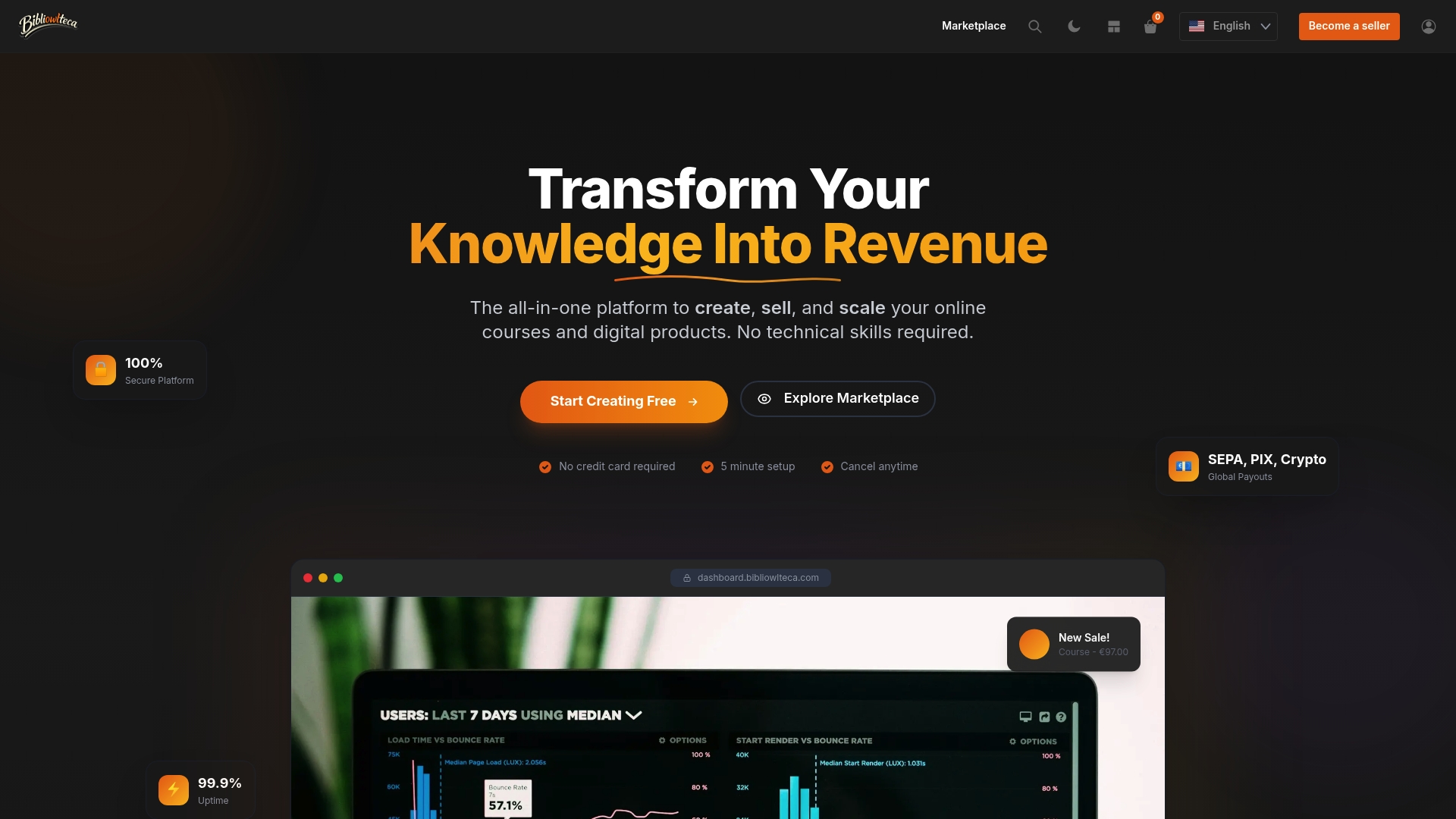
To see how finished products look in practice, browse the e-book, course, template and download categories, or look at examples such as finance and business digital downloads.
FAQ
What is a typical platform fee for creators?
There is no single rate. Published structures range from a flat percentage plus a fixed amount per sale to a subscription with a lower cut, to marketplaces that take 30% in exchange for buyer discovery. On a $20 card sale, one 2026 calculator shows creators keeping between $14.00 and $19.12 across common structures. Compare using your own price, not the headline percentage.
Do I pay platform fees when I have no sales?
Only on subscription-style plans. Pay-per-sale platforms charge nothing until an order completes. BibliOWLteca has no monthly fee, and the per-sale fee starts from €0.99.
Do buyers pay platform fees too?
On BibliOWLteca, buyers of educational content, courses, e-books and digital downloads pay no platform fees. The fee is charged to the creator on completed sales. Other platforms may add buyer-side charges, so check each checkout.
Why do fixed fees matter more for cheap products?
A fixed amount is the same on every sale, so it takes a bigger bite out of a small price. A $0.50 fee is 10% of a $5 product but about 0.5% of a $99 course. Bundling low-priced items or raising prices spreads that cost.
Do I still owe tax on money I earn through a platform?
Yes. In the US you report all income on your tax return, and platforms that process payments may send the IRS a Form 1099-K when reporting thresholds are met. Ask a CPA how to record fees and refunds. If you sell to European buyers, our built-in European tax compliance covers the VAT side.
Sources
- IRS: Understanding your Form 1099-K
- How to price a digital product after platform fees
- Creator platform fee calculator
- Digital product pricing calculator
- Best English teaching platforms
- How to reduce academic book costs