
TL;DR:
- Resource sharing involves pooling tools and content to increase access and reduce costs among creators and educators. It delivers benefits such as lower expenses, broader access, stronger collaboration, and environmental sustainability. Effective sharing requires trust, clear protocols, suitable digital infrastructure, and strategic implementation for long-term success.
Resource sharing is defined as the practice of pooling tools, knowledge, materials, or content across individuals or groups to maximise collective access and reduce individual cost. For content creators, educators, and professionals, understanding the importance of resource sharing is not optional. It is the difference between working in isolation and building something that compounds. Pooling resources increases access and reduces costs effectively, making it one of the most practical strategies available to anyone building a knowledge-based career or business.
What are the primary benefits of resource sharing?
Resource sharing delivers four measurable advantages: lower costs, broader access, stronger collaboration, and reduced environmental impact. Each one compounds the others.
Lower costs and wider access
Individual purchasing is expensive. When creators and educators share tools, templates, research databases, or software licences, they eliminate redundant spending. Sharing economy models reduce household material consumption by up to 25% for specific product categories. That figure applies directly to professional contexts: shared subscriptions, co-licensed platforms, and pooled content libraries all cut per-person expenditure significantly.

Access expands in parallel. A single educator working alone can only afford so many resources. A network of ten educators sharing a digital library multiplies what each person can offer their students without multiplying their budget.
Environmental and social impact
The environmental case for sharing is concrete. One car-sharing vehicle replaces up to 13 private cars, reducing ownership burden and emissions at scale. The same logic applies to digital infrastructure: shared hosting, shared platforms, and shared content reduce the energy and cost of duplicated systems.
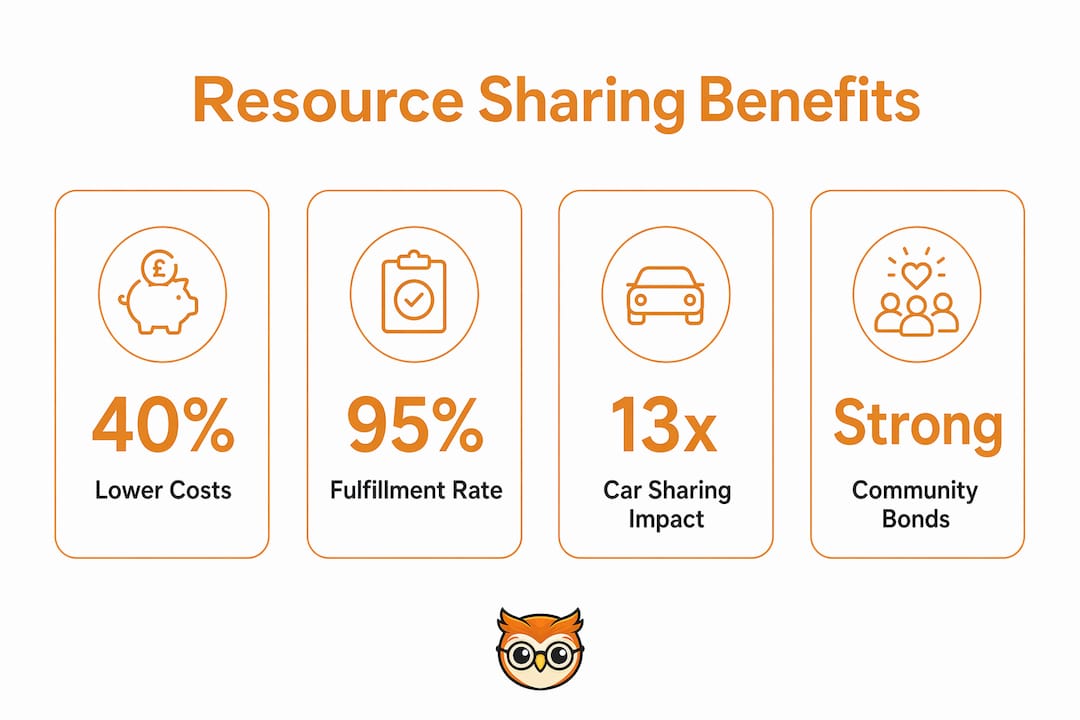
Beyond the environment, sharing builds community. Sharing reduces stress and isolation while strengthening mental resilience and social connection. For educators and creators who often work independently, this social dimension is not a soft benefit. It is a structural one that sustains long-term productivity.
Pro Tip: Map your current tool subscriptions against those of three or four peers in your field. You will almost certainly find overlap worth consolidating into a shared arrangement.
Sustainability experts advocate shifting from market-driven allocation to participatory models that prioritise equity and ecology. For creators and educators, this means choosing platforms and networks that distribute value fairly rather than concentrating it at the top.
How do different resource sharing models compare?
Three primary models define how resource sharing operates in practice: peer-to-peer networks, consortia, and institutional networks. Each suits different scales and contexts.
Peer-to-peer, consortia, and institutional networks
Peer-to-peer sharing connects individuals directly. Creators swap templates, lesson plans, or editing tools through platforms like Google Drive, Notion, or shared Dropbox folders. The barrier to entry is low, but governance is informal and trust depends entirely on personal relationships.
Consortia are formal agreements between organisations, typically libraries, universities, or professional associations, to share catalogues and resources. The British Library's document supply service is a well-known example. Consortia offer structure and scale but require negotiated agreements and administrative overhead.
Institutional networks sit between the two. A school district sharing curriculum resources across its schools, or a media company sharing asset libraries across its editorial teams, operates at this level. Speed and reliability are higher than peer-to-peer, but flexibility is lower than a consortium.
Advanced digital sharing networks achieve fulfilment rates of approximately 95%, with average delivery times under 12 hours for digital documents. That performance benchmark shows what well-structured sharing infrastructure can deliver.
Comparing models on key metrics
| Model | Cost | Speed | Trust Requirement | Best For |
|---|---|---|---|---|
| Peer-to-peer | Very low | Variable | High (personal) | Small creator networks |
| Consortia | Medium | Fast (structured) | Moderate (contractual) | Libraries, universities |
| Institutional | Low to medium | Fast (automated) | Low (systemic) | Schools, media teams |
| Digital platforms | Low | Near-instant | Low (platform-governed) | Global creator audiences |
Digital platforms sit in a category of their own. Tools built specifically for digital distribution for educators remove the friction of traditional models entirely. They handle delivery, payment, and access control automatically, which means creators can share at scale without managing logistics manually.
Pro Tip: If you are starting a sharing arrangement with peers, agree on a simple written protocol before you begin. Define what is shared, how long access lasts, and what happens if someone leaves the group. Informal agreements collapse under ambiguity.
What are the challenges of effective resource sharing?
Resource sharing fails most often not because of technology, but because of trust, protocol, and visibility. Understanding these barriers is the first step to avoiding them.
Trust and social capital
Trust is the primary currency in sharing systems. Without it, participants worry about availability, reliability, and whether shared assets will be returned or respected. This anxiety reduces participation and degrades the quality of the network over time.
Building trust requires consistency. Show up reliably, contribute before you extract, and honour agreements. In digital contexts, platform-level trust mechanisms such as ratings, verified identities, and usage logs substitute for personal relationships and lower the barrier for strangers to share effectively.
Protocols, visibility, and misuse
Clear operational protocols with fixed turnaround times and automated catalogue visibility are non-negotiable for successful sharing at scale. Without them, delays accumulate and participants lose confidence in the system.
Common failure points include:
- No clear catalogue. If participants cannot see what is available, they cannot request it. Shared libraries without searchable indices are functionally invisible.
- Undefined turnaround expectations. Ambiguity about when a resource will be returned or delivered creates friction and resentment.
- No misuse policy. Shared assets get misused when there are no stated consequences. A brief user agreement prevents most problems.
- Unequal contribution. Networks where some members only take and never contribute collapse quickly. Build reciprocity into the structure from the start.
Measuring whether sharing is actually saving money matters too. Objective ROI measurement using tools like OCLC's Interlibrary Loan Cost Calculator is critical. Never assume sharing is cheaper by default. Verify it with data.
Technology infrastructure
Catalogue visibility is a technical problem as much as a social one. Shared resources that live in disorganised folders or outdated spreadsheets are effectively inaccessible. Investing in a shared platform with proper tagging, search, and access controls pays for itself quickly in time saved.
Library trends in 2026 show that digital platforms with automated cataloguing and access management are becoming the standard for educational resource sharing. Creators and educators who adopt these tools early gain a structural advantage over those still managing sharing manually.
How can creators and educators implement resource sharing?
Practical implementation follows a clear sequence. The steps below move from audit to action, and each one builds on the last.
A step-by-step framework for sharing resources
-
Audit what you already have. List every tool, template, course asset, research database, and piece of content you currently use. Identify what you use regularly and what sits idle. Idle resources are your first sharing opportunity.
-
Identify community needs. Talk to peers, students, or colleagues. Ask what they are spending money on that you already have access to. This conversation reveals the natural exchange points in your network.
-
Choose the right platform for your scale. Peer-to-peer sharing works for small groups. For broader distribution, a dedicated digital platform handles delivery, access control, and payment automatically. Digital learning frameworks show that structured platforms consistently outperform ad-hoc arrangements for both reach and reliability.
-
Build partnerships with peers. Formal partnerships, even simple written agreements, produce better outcomes than informal arrangements. Define what each party contributes, how access works, and how the arrangement evolves over time.
-
Exchange skills, not just assets. Resource sharing extends beyond files and tools. A graphic designer who shares templates with a copywriter, in exchange for editing support, creates a reciprocal relationship that neither money nor software can replicate. Skill exchange is one of the most underused forms of collaborative resource management.
-
Practise sustainable and equitable sharing. Set contribution expectations from the start. Rotate curation responsibilities. Review the arrangement periodically to confirm it still serves everyone fairly. Sharing arrangements that feel one-sided do not last.
-
Track the impact. Measure time saved, money not spent, and new capabilities gained. Use this data to refine the arrangement and demonstrate its value to new potential partners.
Pro Tip: Start with one resource, not ten. Offer a single high-value asset to your network and observe how people engage with it. The response tells you exactly what to share next.
Libraries have long modelled this approach at institutional scale. Libraries drive educational success across all ages precisely because they institutionalise the logic of shared access. Creators and educators who build similar structures within their own networks replicate that success at a smaller, more personal scale.
The resource sharing advantages available to creators in 2026 are greater than at any previous point. Digital infrastructure has removed most of the logistical barriers that made sharing difficult. The remaining barriers are social and organisational, and those are solvable with the steps above.
Key takeaways
Effective resource sharing requires trust, clear protocols, and the right digital infrastructure to deliver lasting benefits for creators and educators.
| Point | Details |
|---|---|
| Define before you share | Audit existing resources and identify community needs before building any sharing arrangement. |
| Choose the right model | Peer-to-peer suits small groups; digital platforms suit creators reaching broader audiences. |
| Trust drives participation | Build trust through consistency, reciprocity, and clear written agreements from the outset. |
| Measure actual savings | Use objective cost tools to verify sharing reduces expenditure rather than assuming it does. |
| Social benefits are structural | Sharing reduces isolation and builds community resilience, sustaining long-term creative output. |
Why resource sharing is more than an economic decision
Most conversations about resource sharing focus on cost. That framing is too narrow, and in my experience working with creators and educators, it misses the most durable reason to share.
Oxytocin release during reciprocal altruism builds resilient, connected communities. That is not a metaphor. It is a neurological mechanism. When people share resources reliably and receive in return, they form bonds that outlast any individual transaction. Those bonds are what make creative networks survive difficult periods, not spreadsheets or platform features.
The creators and educators I have seen build the most sustainable careers are not the ones with the most tools. They are the ones embedded in the most generous networks. They share early, share often, and build reputations as contributors before they ever ask for anything in return. That reputation becomes a resource in itself, one that no subscription can replicate.
There is also an equity argument that does not get enough attention. Participatory resource allocation improves social equity and environmental sustainability in ways that market-driven models structurally cannot. For educators working in under-resourced contexts, sharing is not a nice-to-have. It is the mechanism that makes quality education possible at all.
My honest view is that the creators and educators who treat sharing as a core professional practice, rather than an occasional convenience, will outperform those who do not. Not because sharing is virtuous, though it often is, but because it compounds. Every resource shared builds a relationship. Every relationship expands what you can access. Every expansion increases what you can produce. That cycle does not have a ceiling.
— Bibliowlteca
Share your knowledge further with Bibliowlteca
Bibliowlteca is built for creators and educators who are ready to move beyond informal sharing and build a real digital business around their knowledge.

With Bibliowlteca, you can publish and sell digital content including e-books, courses, and other educational products to a global audience. The platform handles payment processing, digital delivery, and tax compliance across multiple currencies, so you focus on creating rather than administering. Whether you are sharing a single resource or building a full catalogue, Bibliowlteca gives you the infrastructure to do it at scale. Explore the full range of creator and educator features and see how far your knowledge can travel.
FAQ
What is resource sharing and why does it matter?
Resource sharing is the practice of pooling tools, knowledge, or materials across individuals or groups to increase access and reduce costs. It matters because it expands what any single creator or educator can offer without proportionally increasing their expenditure.
What are the main benefits of resource sharing for educators?
The primary benefits include reduced costs, broader access to materials, stronger peer collaboration, and measurable environmental impact. Sharing economy models can reduce material consumption by up to 25% in specific categories.
How do digital platforms improve resource sharing?
Digital platforms achieve fulfilment rates of approximately 95% with delivery times under 12 hours for digital documents. They automate catalogue visibility, access control, and delivery, removing the logistical barriers that make informal sharing unreliable.
What are the biggest challenges in resource sharing?
Trust, unclear protocols, and poor catalogue visibility are the three most common failure points. Defining turnaround expectations, contribution requirements, and misuse policies at the outset prevents most problems before they occur.
How can content creators start sharing resources effectively?
Start by auditing existing tools and identifying what peers need. Choose a platform suited to your scale, establish a written agreement, and track the impact. Beginning with one high-value resource and observing engagement is the most reliable way to build a sharing network that lasts.