

TL;DR:
- Citations acknowledge sources in academic writing, linking in-text markers to full reference entries. Proper citation practice is vital to avoid plagiarism, establish credibility, and enable source verification. Citation metrics like FWCI and h-index measure research impact but require careful interpretation within disciplinary contexts.
A citation is the standardised method used in academic and professional writing to acknowledge the origin of ideas, data, or quotations drawn from other sources. Every time you quote, paraphrase, or build on someone else's work, a citation formally records that debt. The practice underpins scholarly communication by allowing readers to trace claims back to their origins, verify evidence, and understand how new work fits within existing knowledge. Standards such as APA, Harvard, MLA, and Chicago each govern how citations are formatted, but the core purpose remains constant: to credit authorship and preserve academic integrity.

What is a citation and how does it work?
A citation is a two-part formal system: a brief in-text marker embedded within your writing, paired with a full bibliographic entry in a reference list or bibliography at the end of your document. The in-text marker points the reader to the full entry, which supplies all the details needed to locate the original source. Without both parts working together, the citation is incomplete and functionally useless.
The in-text marker typically takes one of three forms depending on the citation style you use. Parenthetical styles such as APA and Harvard place the author's surname and publication year directly in the text, for example (Smith, 2023). Numerical styles such as Vancouver use a superscript number that corresponds to a numbered list of references. Footnote styles such as Chicago place a superscript number that links to a note at the bottom of the page, where the full reference appears.
The full bibliographic entry in the reference list contains the information a reader needs to find the source independently. That typically includes the author's name, the year of publication, the title of the work, the publisher or journal name, and where relevant, the volume, issue, page numbers, and a DOI or URL. Each citation style arranges these elements in a specific order and format, so switching styles mid-document creates inconsistency and confusion.
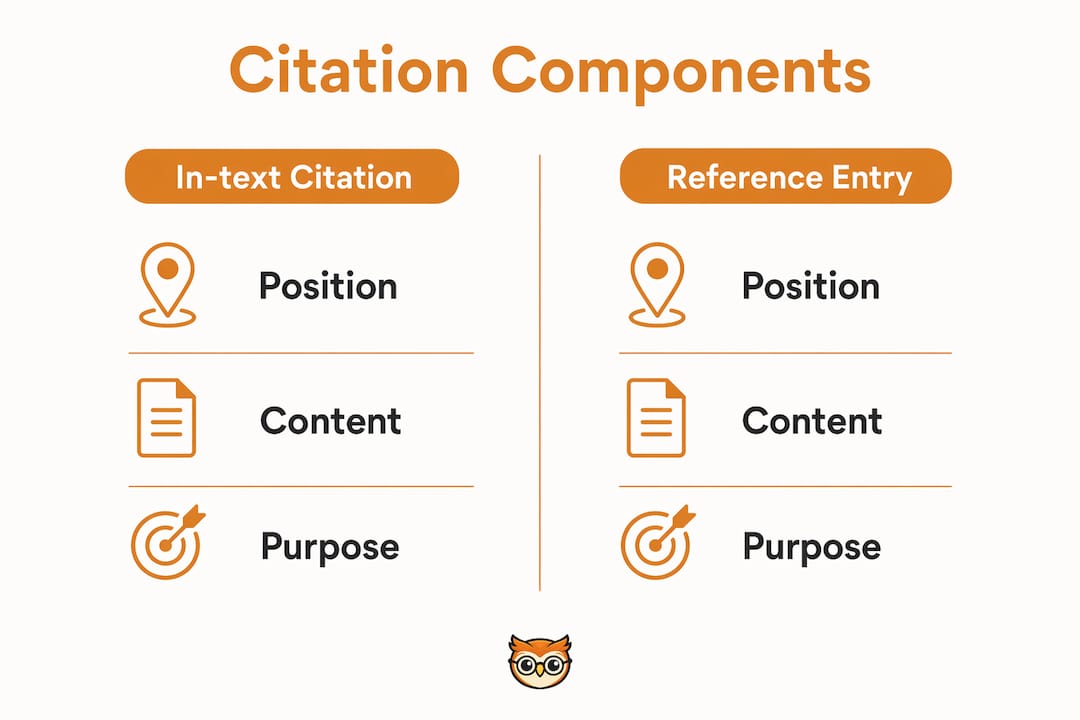
The table below compares the key features of in-text citations and reference list entries side by side.
| Feature | In-text citation | Reference list entry |
|---|---|---|
| Position in document | Embedded within the body text | Appended at the end of the document |
| Length | Brief (author, year, or number) | Full bibliographic details |
| Purpose | Signals a source has been used | Provides complete source information |
| Reader action | Prompts the reader to check the reference list | Allows the reader to locate the original source |
| Common errors | Missing page numbers, wrong year | Incomplete author details, missing DOI |
Pro Tip: Check every in-text citation against its reference list entry before submitting any piece of work. Mismatches between the two parts are among the most common reasons manuscripts are rejected or essays receive grade deductions.
Why is citation essential in academic and professional writing?
Citing sources is mandatory, not optional. Failure to cite whenever you quote, paraphrase, or use another person's ideas constitutes plagiarism, which carries serious institutional and professional consequences. Universities, publishers, and research bodies treat plagiarism as a breach of academic integrity, and the penalties range from failed assignments to permanent exclusion from a programme or profession.
Beyond avoiding penalties, citations establish credibility. When you cite a peer-reviewed study or a recognised authority, you signal to your reader that your claims rest on verified evidence rather than personal opinion. That traceability is what separates scholarly writing from commentary. A reader who doubts your claim can follow the citation trail back to the original source and assess the evidence themselves.
Institutional policies at universities and journals require proper citation as a condition of publication or assessment. Most institutions publish explicit referencing guidelines, and many journals will desk-reject a manuscript that does not conform to their required style. The expectation is not merely stylistic; it reflects a commitment to transparency and the reproducibility of knowledge.
The consequences of improper or absent citation include:
- Failed assessments or grade deductions in academic coursework
- Manuscript rejection by journals or conference proceedings
- Retraction of published work if plagiarism is discovered after publication
- Damage to professional reputation that can persist throughout a career
- Legal liability in commercial or journalistic contexts where intellectual property rights apply
Pro Tip: Keep a running source log as you research. Record the full bibliographic details of every source the moment you consult it. Reconstructing reference details after writing is time-consuming and error-prone. Tools such as Zotero or Mendeley can automate this process.
What is citation analysis and how is citation impact measured?
Citation analysis is the systematic study of how often and in what contexts scholarly works are cited by other researchers. Citation analysis helps researchers and institutions understand the significance of a piece of work by tracking where it has been cited and revealing patterns of influence across a field. It belongs to the broader discipline of bibliometrics, which applies quantitative methods to the study of academic literature.
Several metrics are used to quantify citation impact. The most widely recognised include:
| Metric | What it measures | Key limitation |
|---|---|---|
| Citation count | Total number of times a work has been cited | Does not account for field size or publication year |
| Journal impact factor | Average citations per article in a journal over two years | Measures the journal, not individual articles |
| h-index | Number of papers (h) each cited at least h times | Favours longevity over recent high-impact work |
| Field-Weighted Citation Impact (FWCI) | Citations received relative to the global average for the field | Requires normalisation data; less intuitive |
FWCI greater than 1.00 indicates that a work has received above-average citations compared to similar publications in the same field and year. That makes FWCI one of the more reliable metrics for cross-disciplinary comparisons, because it accounts for the fact that citation cultures differ enormously between fields.
Eugene Garfield developed the journal impact factor to measure journal-level importance, but its misuse can lead to incorrect evaluations of individual articles. A paper published in a lower-impact journal may accumulate more citations than several papers in a prestigious journal. Judging a researcher solely by the impact factor of the journals they publish in is therefore a flawed approach.
Citation metrics also carry structural limitations that researchers and evaluators must recognise:
- Citation counts used for tenure and promotion decisions require qualitative judgement alongside quantitative data, because metrics alone cannot capture the nature or quality of scholarly influence.
- Citation rates vary significantly by discipline. A paper in mathematics may accumulate far fewer citations than one in biomedicine, even if both are equally influential within their fields.
- No single citation database covers all scholarly literature. Relying on one database alone can produce an incomplete picture of a work's true impact.
- Self-citation inflates counts without reflecting genuine external influence.
- Negative citations, where a work is cited to be criticised or refuted, count the same as positive ones in raw totals.
For a thorough understanding of how bibliometrics boost research impact, it helps to treat citation metrics as one lens among several rather than a definitive verdict on scholarly worth.
What are the main citation styles and how do you cite sources correctly?
The five citation styles most commonly required in academic and professional writing are Harvard, APA, MLA, Chicago, and MHRA. Each style was developed for a specific disciplinary context. APA (American Psychological Association) dominates the social sciences. MLA (Modern Language Association) is standard in humanities and literary studies. Chicago is used widely in history and publishing. MHRA (Modern Humanities Research Association) is common in British humanities programmes. Harvard is a broad author-date style used across many disciplines, particularly in the United Kingdom and Australia.
How in-text citation formats differ
Parenthetical styles (Harvard, APA, MLA) place source information directly in the text within brackets. Numerical styles (Vancouver, IEEE) replace the author-date with a number that corresponds to a numbered reference list. Footnote styles (Chicago, MHRA) use superscript numbers that link to notes at the foot of the page or the end of the chapter. The choice of format affects how your text reads and how much information the reader sees without consulting the reference list.
Steps to format a citation correctly
- Identify the source type. A journal article, book, book chapter, website, and conference paper each require different formatting. Confirm which template applies before you begin.
- Gather all required elements. Collect the author name(s), publication year, title, publisher or journal name, volume and issue numbers, page range, and DOI or URL as applicable.
- Apply the correct style template. Use the official style guide or a verified institutional guide to arrange the elements in the required order and punctuation.
- Insert the in-text marker. Place the abbreviated reference (author, year, or number) at the point in your text where the source is used, immediately after the quoted or paraphrased material.
- Add the full entry to your reference list. Append the complete bibliographic entry to your reference list or bibliography, ensuring it matches the in-text marker exactly.
- Cross-check both parts. Verify that every in-text citation has a corresponding reference list entry and that all details match.
Accurate reference lists are not a finishing touch; they are the backbone of a credible piece of writing. A single missing or incorrect entry can undermine the reader's trust in the entire document.
Pro Tip: Match your citation style to your discipline before you begin writing, not after. Reformatting an entire reference list from APA to MHRA at the submission stage wastes hours. Check your institution's or journal's author guidelines on day one.
Key takeaways
A citation is a two-part system linking an in-text marker to a full bibliographic reference, and both parts must be accurate, complete, and consistent for the citation to serve its purpose.
| Point | Details |
|---|---|
| Definition of citation | A citation formally acknowledges the source of an idea, quote, or data point used in your writing. |
| Two-part structure | Every citation requires an in-text marker and a matching full entry in the reference list. |
| Avoiding plagiarism | Failing to cite sources constitutes plagiarism and carries serious academic and professional penalties. |
| Citation impact metrics | Metrics such as FWCI, h-index, and citation counts measure research influence but must be interpreted within disciplinary context. |
| Choosing a citation style | Match your style (Harvard, APA, MLA, Chicago, MHRA) to your discipline and institution before you begin writing. |
Citations are the grammar of scholarly trust
Most students treat citations as an administrative chore, something to sort out after the real writing is done. That attitude is the root cause of most referencing errors I see. Citations are not decoration. They are the mechanism through which scholarly work becomes interconnected and accountable rather than a series of unattributed assertions.
The shift to digital writing tools has made citation management easier in one sense and more treacherous in another. Reference management software can generate formatted entries automatically, but it can also propagate errors at scale. A wrongly imported DOI or a misidentified source type will replicate across every document you use it in. The tool does not check whether the source actually says what you claim it says. That judgement remains yours.
Citation analysis metrics deserve the same scepticism. Researchers and hiring committees increasingly rely on h-index scores and impact factors to make consequential decisions about careers and funding. The numbers feel objective, but field-dependent citation cultures mean that a physicist and a philosopher with identical h-index scores are not equally cited within their respective communities. Normalised metrics like FWCI exist precisely because raw counts mislead.
The most common mistake I observe among early-career researchers is treating citation as a box-ticking exercise rather than an act of intellectual honesty. Every citation you include is a claim that the source supports your argument. If you have not read the source carefully enough to know whether it does, the citation is worse than absent. It is misleading. Rigorous citation practice starts with rigorous reading, and no software shortcut replaces that.
— BibliOWLteca
Strengthen your academic writing with Bibliowlteca
Proper citation practice sits at the heart of credible academic and professional writing. Bibliowlteca offers a growing library of digital resources designed to help students, researchers, and writers build stronger referencing skills and deepen their understanding of scholarly communication.

Whether you are looking for guides on digital marketing for academic content or structured e-books that walk you through referencing conventions step by step, Bibliowlteca provides the tools to turn knowledge into practice. The platform supports multiple formats and global delivery, so the right resource reaches you wherever you are working. Browse the full catalogue and find the materials that match your current stage of learning.
FAQ
What is a citation in simple terms?
A citation is a formal reference that tells your reader where an idea, quote, or piece of data originally came from. It consists of a brief in-text marker and a full entry in your reference list.
What is the difference between a citation and a reference?
A citation is the brief marker placed within your text at the point where a source is used. A reference is the full bibliographic entry in the reference list at the end of your document. Both are required and must match each other exactly.
What is citation analysis?
Citation analysis is the study of how often and in what contexts scholarly works are cited by other researchers. It uses metrics such as citation counts, h-index, and FWCI to assess research influence within a field.
What is citation impact and why does it matter?
Citation impact measures how much influence a piece of research has had on subsequent scholarship, typically through citation counts or normalised metrics like FWCI. It matters because institutions use it to evaluate research quality for funding, tenure, and promotion decisions.
How do I choose the right citation style?
Match your citation style to your discipline and the requirements of your institution or target journal. APA suits the social sciences, MLA suits humanities, Harvard is common across British universities, and Chicago is standard in history and publishing.