
Peer review is the process by which independent experts in a given field critically evaluate a piece of research before it is published. It acts as the primary quality filter in academic and scientific publishing, separating work that meets professional standards from work that does not. Without it, scholarly communication would have no reliable mechanism for distinguishing rigorous findings from speculation or error.
The process has been formalised in scientific communication for over 300 years, with the Royal Society's Philosophical Transactions among the earliest journals to implement it systematically. A 2015 survey found that 82% of researchers believe scientific communication would lack adequate control without peer review. That consensus has held, even as the system itself has attracted sustained criticism.
What is peer review and why does it underpin research?
Peer review subjects an author's scholarly work to the scrutiny of others who are experts in the same field. Its two core purposes are to filter out low-quality or flawed research before it enters the public record, and to improve manuscripts that are broadly sound but need strengthening. Those purposes are distinct, and both matter.
Historically, the Royal Society formalised the practice in the 17th century, though informal expert evaluation of scientific claims predates that by centuries. What the Royal Society established was a structured, institutional version: a third party, independent of both author and publisher, assessing the work on its merits. That structure remains the template today.
Peer review also functions as a form of professional self-regulation. Researchers, as a community, set the standards by which their own work is judged. This is why most scientists will not treat a finding as credible unless it has passed through the process. As one widely cited characterisation puts it, without that external seal of approval, results are treated as preliminary and potentially flawed, carrying roughly the same weight as a press release.
Key functions peer review serves:
- Validates the originality, significance, and accuracy of research findings
- Identifies methodological errors, missing references, or unsupported conclusions
- Encourages authors to meet the accepted standards of their discipline before submission
- Provides editors with expert guidance on whether a manuscript is suitable for publication
- Signals to policymakers and the public that research has been independently scrutinised
How does peer review work in practice?
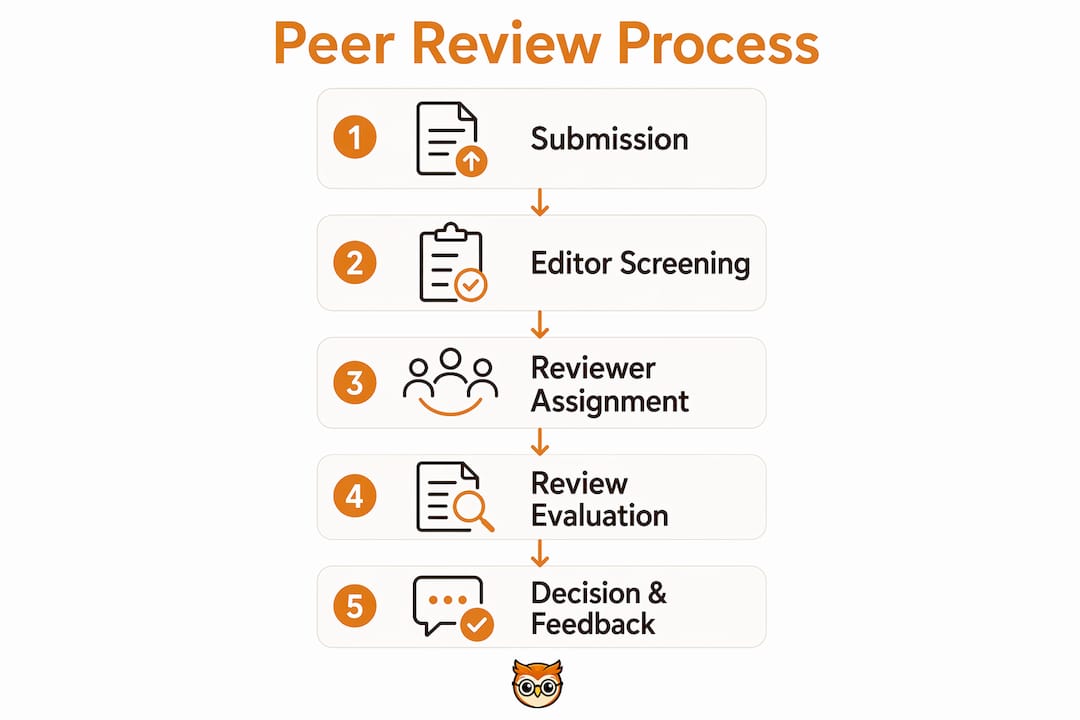
The standard peer review process follows a clear sequence, though the timeline and detail vary by journal and discipline.

A researcher completes a study, writes a manuscript describing the purpose, design, results, and conclusions, then submits it to a journal. The editors first assess whether the subject matter fits the journal's scope. Very few papers pass this initial check without revision or outright rejection. Those that do are sent to two or three independent experts in the relevant field for formal review.
Reviewers read the manuscript carefully and assess several dimensions:
- Validity of the science: Is the methodology sound? Are the conclusions supported by the data?
- Quality of experimental design: Were appropriate controls used? Are the methods reproducible?
- Significance and novelty: Does the work advance the field, or does it replicate what is already known?
- Clarity and accuracy: Is the writing clear? Are references correct and complete?
- Ethical considerations: Does the study meet ethical standards for research involving human participants or animals?
Reviewers then submit a recommendation: accept, reject, or revise and resubmit. Their feedback is typically confidential and directed to the editor, who mediates between reviewer requests and the author's response. The editor makes the final call, sometimes overruling reviewer recommendations that fall outside the study's stated scope. The role of editors in this process is more active than it might appear from the outside.
Peer review quality depends heavily on reviewer expertise and available time. Feedback can range from collegial and constructive to highly critical, reflecting genuine professional differences rather than any failure of the system itself.
What are the main types of peer review?
Three models dominate academic publishing, each making a different trade-off between transparency and objectivity.
- Single-blind review: Reviewers know who the authors are, but authors do not know who reviewed their work. This is the most common model. It protects reviewers from potential reprisals but leaves authors exposed to any bias a reviewer might hold based on their institution, nationality, or prior work.
- Double-blind review: Both author and reviewer identities are concealed from each other. The aim is to reduce social bias, though in practice, writing style, subject matter, and cited references often make authors identifiable to experienced reviewers in a narrow field.
- Open peer review: Identities of both parties are disclosed, and in some versions the review reports themselves are published alongside the article. Journals such as those published by Wiley and Elsevier have piloted open review models, as has the Royal Society through its journals. Transparency is higher, but some reviewers are less willing to write frank assessments when their names are attached.
A 2018 COPE survey found that bias remains a top concern in peer review, particularly around diversity, equity, and inclusion. No model fully eliminates the problem. Double-blind review reduces some forms of social bias; open review introduces accountability but may soften critical feedback. The choice of model reflects a journal's priorities, not a settled answer.
In the UK, major publishers including Elsevier, Wiley, and the Royal Society operate across all three models depending on the journal. The Royal Society in particular has been active in piloting transparent review practices, publishing reviewer reports for selected journals since 2015.
Pro Tip: When submitting to a journal, check which review model it uses. If you are early-career or from an institution with less name recognition, double-blind journals may give your work a fairer initial reading.
Why does peer review matter for research and society?
Peer review improves research in ways that are easy to underestimate. The knowledge that a manuscript will be scrutinised by experts raises the standard of the work before it is even submitted. Authors self-correct, add missing controls, and sharpen their arguments in anticipation of expert scrutiny. That pre-submission effect is invisible in the published record but real.
Beyond improving individual papers, peer review builds the trust that makes scientific knowledge usable. Policymakers, clinicians, and journalists rarely have the technical expertise to evaluate primary research themselves. Peer review provides the signal they rely on: this work has been checked by people who do understand it. The societal value of that signal is particularly clear in medicine and public health, where a false claim reaching the public without scrutiny can lead to harmful treatments or unjustified public alarm.
Core benefits peer review delivers:
- Filters out flawed, fraudulent, or low-quality research before it enters the public record
- Improves manuscripts through expert feedback, often requiring additional experiments or clearer analysis
- Establishes credibility for published findings, making them usable by non-specialist audiences
- Maintains community standards across disciplines, creating shared expectations for what counts as good research
- Supports academic networking, since reviewing exposes researchers to current work in their field before it is published
Peer review also serves as a check on spectacular but unsupported claims. Without it, findings that challenge established understanding carry no more weight than the author's own assertion. The process adds independent verification, which is particularly important when findings are counterintuitive or commercially significant.
What are the criticisms and limitations of peer review?
Peer review has real weaknesses, and acknowledging them honestly is part of understanding the system. The most persistent criticism concerns bias. Reviewers are human, and their assessments can be influenced by factors that have nothing to do with the quality of the research: the author's institution, gender, nationality, or whether the findings align with the reviewer's own theoretical commitments.
Single-blind review, the dominant model, is particularly vulnerable here. Reviewers who know an author's identity may unconsciously favour work from prestigious institutions or well-known researchers. This is what peer review bias looks like in practice: not necessarily deliberate, but structurally embedded in a system where reviewer identity is protected but author identity is not.
Other significant limitations include:
- Slow turnaround: Review cycles can take months, delaying the dissemination of findings that may be time-sensitive, particularly in fast-moving fields like infectious disease research.
- Subjectivity: Two reviewers assessing the same manuscript can reach opposite conclusions. Acceptance or rejection sometimes reflects the luck of reviewer selection as much as the quality of the work.
- Reviewer workload: The volume of manuscripts submitted to journals has grown substantially, but the pool of qualified reviewers has not kept pace. Overloaded reviewers produce shorter, less thorough assessments.
- Limited fraud detection: Peer review is not designed to detect data fabrication or image manipulation. It evaluates plausibility and methodology, not raw data integrity.
- Anonymity concerns: Confidential review can shield poor-quality or biased assessments from accountability. Reviewers who know their reports will never be seen publicly have less incentive to be thorough.
Efforts to address these problems include open peer review, post-publication peer review platforms, and structured reviewer training programmes. None has yet replaced the traditional model, but the conversation about reform is active, particularly within UK research institutions and funding bodies such as UK Research and Innovation.
How is peer review evolving in the UK research landscape?
Peer review is a checkpoint, not a certificate of truth. That distinction matters more than it might seem. A peer-reviewed paper has been assessed by experts and found to meet the standards of its field at the time of review. It has not been proven correct. Science advances by accumulating evidence across many studies, and individual peer-reviewed papers are one input into that process, not the final word.
This framing is gaining traction in the UK research community, partly in response to high-profile replication failures in psychology and medicine during the 2010s. The response has not been to abandon peer review but to contextualise it more honestly and to push for greater transparency in how it operates.
Current trends shaping the future of peer review in the UK:
- Open peer review adoption: Journals affiliated with the Royal Society, Wiley, and Elsevier have expanded open review options, publishing reviewer reports and allowing readers to assess the quality of the evaluation alongside the paper itself.
- Registered reports: Some journals now accept study protocols for peer review before data collection begins, reducing publication bias by committing to publish results regardless of outcome.
- Reviewer training: Organisations including the Committee on Publication Ethics (COPE) offer structured guidance for new reviewers, addressing a long-standing gap in how reviewing skills are developed.
- Preprint culture: Platforms such as bioRxiv and medRxiv allow researchers to share findings before peer review, accelerating dissemination while keeping the formal review process as a subsequent quality check.
- Reviewer recognition: There is growing pressure on journals and institutions to formally recognise reviewing as a professional contribution, addressing the altruism problem where experienced researchers bear the burden of reviewing without formal credit.
Bibliowlteca supports this broader shift toward open scholarly communication by providing creators and educators with the tools to publish and distribute knowledge-based content globally, including resources that explain and contextualise academic processes like peer review for wider audiences.
Pro Tip: If you are new to peer reviewing, COPE's free reviewer guidelines are a practical starting point. They cover how to structure feedback, manage conflicts of interest, and write assessments that are genuinely useful to authors and editors.
Who are the key stakeholders in the peer review process?
Three groups make peer review function: authors, reviewers, and editors. Each carries distinct responsibilities, and the process breaks down when any one of them fails to meet them.
Authors submit their work and are responsible for the accuracy, completeness, and honesty of what they present. They respond to reviewer feedback, either revising the manuscript or explaining why a suggested change is not warranted. The anticipation of expert scrutiny shapes how authors write and what they include, which is one of peer review's less visible but genuine benefits. Understanding the role of journals in academia helps authors navigate submission expectations more effectively.
Reviewers are the experts who assess the manuscript. They work without payment in most cases, contributing time and expertise as a form of community service. Their feedback should be specific, constructive, and grounded in the evidence presented. Reviewing also benefits the reviewer: exposure to current research before publication sharpens critical skills and keeps reviewers current in their field. This dual function, altruistic service and professional development, is what sustains the system despite its demands.
Editors coordinate the entire process. They select appropriate reviewers, manage timelines, mediate disputes between authors and reviewers, and make the final publication decision. A good editor does not simply defer to reviewer recommendations; they weigh the quality of the review itself, the journal's scope, and the broader significance of the work. The editor's judgement is the last substantive check before a paper enters the published record.
How does peer review shape the publication decision?
The peer review process directly determines whether a manuscript is accepted, revised, or rejected. Editors rely on reviewer recommendations as the primary input, but the decision is theirs alone.
Outcomes typically fall into four categories:
- Accept as submitted: Rare. Reserved for manuscripts that require no substantive changes.
- Minor revisions: The paper is broadly acceptable but needs small corrections, clarifications, or additional references. Authors are given a short window to respond.
- Major revisions: Significant changes are required, often including additional experiments, reanalysis of data, or substantial rewriting. The revised manuscript usually goes back to the original reviewers.
- Reject: The manuscript is not suitable for the journal, either because of fundamental methodological flaws, insufficient novelty, or a poor fit with the journal's scope. Rejection does not necessarily mean the work is without value; it may be better suited to a different journal.
The same manuscript can receive opposite recommendations from two reviewers, leaving the editor to exercise genuine judgement. This variability is one of peer review's acknowledged weaknesses, but it also reflects the reality that expert assessment of complex research is rarely straightforward. What peer review provides is not a mechanical verdict but a structured, expert-informed input into a human decision. The publishing process in academia depends on that input to maintain the standards that give published research its credibility.
Key takeaways
Peer review remains the most widely accepted method for validating research quality, but it functions as a quality checkpoint rather than a guarantee of scientific truth.
| Point | Details |
|---|---|
| Foundational process | Peer review has been formalised for over 300 years, with the Royal Society among its earliest institutional adopters. |
| Three core models | Single-blind, double-blind, and open peer review each balance transparency and objectivity differently, with no model eliminating bias entirely. |
| Societal trust function | Policymakers and the public rely on peer review as assurance of research validity, since most lack the expertise to evaluate primary research directly. |
| Persistent limitations | Reviewer bias, slow turnaround, and subjectivity remain unresolved, prompting ongoing reform efforts including open review and registered reports. |
| Three key stakeholders | Authors, reviewers, and editors each carry distinct responsibilities; the process depends on all three performing their roles with integrity. |