

A digital product preorder is a sale you make before the ebook, course or template is finished. It works when the page states the outcome, a real delivery date, a founding price and what happens if you miss the date. Done well, it tells you whether anyone will pay before you spend months building. It also funds the work and gives you a first group of buyers who shape the finished product. This guide covers the offer, the price, the launch emails and the delivery promise. It also covers what to do when the date slips. Everything here can run through one storefront and one checkout on BibliOWLteca, where creators sell ebooks, courses and templates.
TL;DR
- A presale is a paid test: a card payment is stronger evidence of demand than likes, replies or waitlist signups.
- Your offer needs a clear result, a real start date, a founding price with a reason, and a refund rule decided before the cart opens.
- A short email sequence, from a "launching soon" note to a final reminder, is enough for a small list.
- Deliver on the date you promised. If you cannot, tell buyers early and offer a refund or a new date they can accept.
- Selling through your own storefront means one checkout, global payment methods and no monthly fee, only a fee when you sell.
Table of Contents
- What a digital product preorder actually is
- Why a payment beats every other signal
- Plan the offer: six elements on one short page
- Set the founding price and the threshold
- Find the first buyers
- A launch email sequence that fits a presale
- Presell on your own storefront
- Perspective: why we think a presale is the right first step
- Deliver on the date you promised
- After the presale: turn founding members into proof
- Run your presale on BibliOWLteca
- A preorder checklist
- FAQ
- Sources
What a digital product preorder actually is
Preselling means opening sales for a product before it is finished, or before it is even started. The product can be an online course, an ebook, a template pack or a mentorship cohort. Some creators sell a finished-in-part product with early chapters or the first module ready. Others sell nothing but an outline and a date.
The usual pattern is a founding-member or beta round. Buyers pay at a lower price, and you build the product with them, often delivering it live over a few weeks. Selling first has three practical benefits, as one creator guide on presales puts it: it can motivate you, it validates an idea through actual purchases, and it can help pay the bills while you create.
A presale differs from a normal launch in one respect. The buyer is paying for a promise, not a finished product. That changes what you owe them: honesty about the state of the product, a firm date, and a clear route to a refund.
Preorder, presale and pre-sell: the same thing
Readers search for "ebook pre order", "course presale" and "presell a course". They all describe the same thing: money in exchange for a product that arrives later. The difference is mostly in what you have built. An ebook preorder often has a manuscript half-written and a release date. A course presale often has an outline and a cohort start date. Your page should say which one it is.
Why a payment beats every other signal
People are generous with encouragement and stingy with money. A business-focused guide to presales argues that a payment is the only signal that proves demand, while likes, replies and waitlist signups do not. It adds that a missed presale costs you a week, while a product nobody wanted costs you months.
Another validation guide makes the same point from the buyer's side: a wishlist signup costs nothing emotionally, while a card charge means someone believed the outcome was worth real money. It says five to ten real buyers tells you more than a hundred people saying that sounds great.
How many buyers is enough? One course-validation lesson suggests that five to ten buyers in a couple of weeks counts as validation. Zero buyers means the idea, the audience or the problem needs adjusting. These are rules of thumb from practitioners, not laws. Treat them as a starting threshold and set your own number, which the planning section below covers.
Plan the offer: six elements on one short page
A presale page should be short. A guide to presell an online course says the offer needs six elements on one page:
- The result the buyer gets.
- Who it is for.
- The format and length.
- A real start date.
- A founding price lower than the final price, and the reason it is lower.
- What happens if it does not run, such as a full refund with no questions.
The same guide says the page should state plainly that the course is not built yet. That honesty reads as confidence. Buyers who know they are joining early forgive rough edges, and they tend to give better feedback.
Write the promise as an outcome
"Eight video lessons on spreadsheets" is a format. "Build a freelance invoicing system in two weeks" is an outcome. Start with the outcome, then give the format and the modules in outline form. One validation guide recommends a single sales page with the promise, the outcome, the modules in outline and a real price, offered at a discount before recording starts, with a clear delivery date and a full refund if you do not ship.
If you want a deeper walk through page structure, our guide to sales pages for creators covers the layout that turns a visitor into a buyer.
The four-line version
If six elements feels like too many, use the shorter test. One practitioner recommends a Four-Line Pre-Sale: the promise, the delivery date, the founding price and the threshold. He advises deciding the threshold and the refund rule before you open the cart, and refunding everyone the same day if the presale misses. Write all four lines, then check that a stranger could understand the offer in ten seconds.
Set the founding price and the threshold
The founding price is a discount with a reason. "Because you are joining before it is finished" is a good reason. It rewards early trust, and it gives you a clean way to raise the price at the public launch without looking arbitrary.
Pick a number in three steps:
- Decide the public price you expect to charge after launch. Our course pricing strategy guide walks through how to arrive at it.
- Set the founding price below it. A modest gap is enough, because the real draw is access and influence over the product.
- Decide your threshold: the minimum number of paid preorders that justifies building the full product. One creator blueprint calls this the Pre-Sale Validation Index. The name matters less than the habit of writing the number down before you start.
A worked example: you plan a $120 course and open a founding round at $79. Your threshold is eight buyers, which is $632 before fees. If you reach eight, you build. If you reach three, you refund them the same day, say what you learned, and adjust the promise or the audience. The numbers are invented for illustration, but the logic holds for any price.
Price in the currency your buyers use. Creators selling beyond their home country gain from a checkout that shows local payment methods. BibliOWLteca supports multiple currencies and payment options including Pix, SEPA, crypto and Klarna, which matters if your founding members are not all in the United States.
Find the first buyers
You do not need a large audience. A small, warm one is enough: people who already know your work, have replied to your emails or asked you a question on the topic. One validation guide aims for a handful of genuine presale buyers from exactly that kind of group.
A creator who documented his own course launch reported $2,054 in presales before the course was built. He used a landing page, a checkout for preorders and a firm launch date of 8 December. That is one account, not a benchmark, but it shows how little infrastructure the test needs: a page, a checkout and a date.
Practical places to start:
- Your email list. The best-converting channel for most creators, and the one you own.
- People who asked you a question. Reply with the outcome you are building and ask if they want early access.
- A five-day social run. One blueprint structures it from a Day 1 post about the frustration and your hypothesis through to a Day 5 final call and door close. A fixed window gives the audience a reason to decide.
- Communities you already contribute to, where you answer questions without selling.
If you run a webinar or live session as part of the offer, our guide to selling webinar courses shows how to package it.
A launch email sequence that fits a presale
The keyword readers type is "course launch email sequence", and the honest answer is that it can be short. A creator who launched a freelancing course on 26 July 2024 used five emails and reported $8,000 in sales in three days:
| When it goes out | |
|---|---|
| Launching Soon | Two days before launch |
| Launches Tomorrow | One day before |
| Course is Here | Launch day |
| FAQ | The day the discount code expires |
| One Final Reminder | The day after |
The account says most conversions came on launch day, and three more customers converted from the FAQ email. The lesson for a presale is that the answer to common doubts is a sales email in its own right.
Larger launches use far more emails. One well-known productivity course sent 11 dedicated launch emails plus a newsletter over 12 days to a list of about 128,000 subscribers. A separate case study describes a 23-email sequence to a list of 45,000, with a pre-launch phase of seven emails over ten days that built anticipation and presold the concept before the cart opened. Those lists are far bigger than most creators have. Copy the structure, not the volume: a warm-up, an open, a set of answers to objections, and a close.
What each email should do
- Warm-up. Name the problem and say you are building something. Give the date the cart opens.
- Open. State the outcome, the founding price, the start date and the refund rule. Link straight to checkout.
- Objections. Answer the questions you have actually been asked: time needed, skill level, what happens if it does not run.
- Close. Say when the founding price ends and why, using the real deadline, not an invented one.
- Follow-up. One short message after the close for anyone who clicked but did not buy.
Notice that the closing emails in the large case studies did a lot of the work. The 23-email case reports that its 12-hour cart-close warning generated $412,000 after 18 earlier emails had built desire and trust. A genuine deadline works, but only when the earlier emails have done their job.
Once a buyer pays, the next message matters as much as any sales email. Our guide to mapping the first onboarding email after payment shows what to send and when.
Presell on your own storefront
A presale only needs a page, a checkout and a way to deliver later. The practical question is where those live. If you stitch together a landing page, a payment form and a spreadsheet of buyers, you also stitch together the places where things go wrong: a buyer pays but is not recorded, a refund is missed, a payment method is unavailable in their country.
BibliOWLteca is built for educational creators who want one place for all of it. You get a customisable storefront, global payments in multiple currencies, course hosting with video and quizzes, mentorship and coaching spaces, community features and analytics. Digital delivery is instant once the product is ready, and hosting is unlimited. Tax compliance for European sales is built in, which saves you from working out VAT yourself when a founding member in Germany or Spain buys.

The pricing suits a test. BibliOWLteca charges no monthly fee. The transaction fee starts from 0.99 EUR per sale, so you pay when you earn. A presale that fills only three seats costs you three small fees, not a month of subscription.
Perspective: why we think a presale is the right first step
Most creators we speak to describe the same fear: months spent on a course that nobody buys. A presale removes that fear by moving the test to the front. You find out whether people pay before you record a single lesson.
We built BibliOWLteca for educators and creators who sell knowledge, so we care about the unglamorous parts: a checkout that accepts the payment method your buyer actually uses, delivery that works the moment a product is ready, and a pricing model that charges only when you earn. Zero monthly fees mean a small founding round carries no fixed cost.
Our advice is to treat founding members as collaborators. Their questions show you where the lessons need more detail, and their testimonials become the proof on your public sales page. Put your outline, your date and your refund rule in front of them, then build in the open.
BibliOWLteca
Deliver on the date you promised
The presale is the easy part. The reputation you build, or lose, comes from what happens next.
Set a delivery plan before you open the cart
Write down, privately, a schedule that works backwards from your promised date. Add a buffer of at least a third of your estimated build time. A late founding round damages trust far more than a slightly later start date announced at the beginning.
Tell buyers what to expect in the confirmation email: the delivery date, how the product arrives (a download link, a course space, a live session) and when the first update will land. Regular small updates reduce refund requests because buyers can see progress.
If you cannot deliver on time
In the United States, the Federal Trade Commission's Mail, Internet, or Telephone Order Merchandise Rule is the reference point for orders taken online. The FTC's business guide says that when you advertise a shipping time, you need a reasonable basis for it, and that without a stated time you need a reasonable basis for believing you can ship within 30 days. If you learn you cannot meet the time, you must seek the customer's consent to the delay. The rule applies to most goods ordered on the internet; whether a particular digital product falls under it can depend on the facts, so ask a lawyer about your own offer if you are unsure.
Whatever the law's reach for your product, the practice is sound:
- Tell buyers as soon as you know, and before the promised date arrives.
- Give a new date you are confident about.
- Offer a choice: wait for the new date or take a full refund.
- Refund promptly to anyone who asks, and keep a record of each refund.
- Say what happened, briefly and plainly. Buyers forgive delay and do not forgive silence.
If the presale misses its threshold
This is the case the refund rule exists for. Refund everyone, ideally on the same day, as one practitioner advises. Then send a short note explaining what you learned and what you will try next. A buyer who was refunded quickly and respectfully is often the first person to join the next round.
Keep the refund policy simple
A clear refund policy on the offer page is part of the product. State when a refund is available (for example, any time before the start date, and if the product does not run) and how a buyer requests it. Taxes and payment-processor fees can affect what comes back to you; check the details of your payment setup, and ask an accountant about the tax treatment of refunded sales in your state.
After the presale: turn founding members into proof
A founding round gives you something no outline can: real use. The questions, sticking points and feedback during the live round shape the finished product, and the testimonials become proof on your sales page.
A simple after-launch routine:
- Log every question in the live round, then add the answer to the course, the ebook or the FAQ.
- Ask for a testimonial a week after delivery, once buyers have a result to describe.
- Raise the price to your planned public price and say that the founding round has closed.
- Review which emails and pages drove sales. Our guide to course analytics lists what to track to protect revenue and outcomes.
- Consider an upsell for founding members, such as templates or a mentorship space. Our piece on converting course upsells shows how to do it from one storefront.
For the bigger picture of taking a course to buyers across countries, read our guide on selling online courses for global success and the broader piece on launching and scaling an education business.
Run your presale on BibliOWLteca
If you have an outline, a date and a small audience, you can open a founding round this week. BibliOWLteca gives you a storefront, global checkout and course hosting with no monthly fee, so a first test does not carry fixed costs. You pay a transaction fee, from 0.99 EUR, only when a sale completes. See the pricing page for the Creator Plan and fee details, or browse the product categories to see how ebooks, courses and templates are presented to buyers.
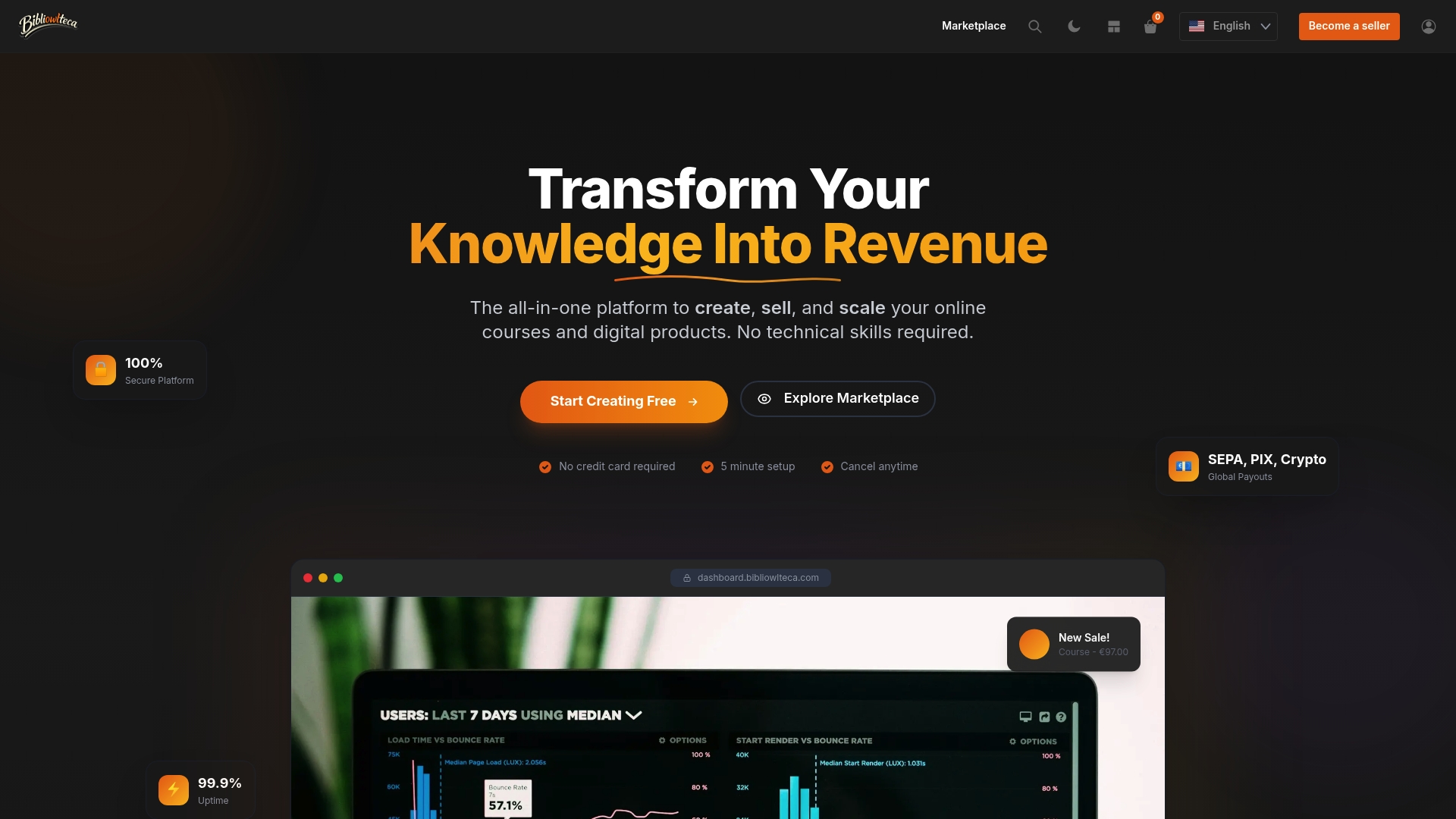
When you are ready, start from your landing page at bibliowlteca.com and set up your storefront before your announcement goes out.
A preorder checklist
Use this before you open the cart:
- The page states the outcome, who it is for, the format and the length.
- The product is described honestly as not finished.
- A real delivery date is on the page.
- The founding price is lower than the public price, with the reason given.
- The threshold number is written down.
- The refund rule is on the page and you can apply it the same day.
- The confirmation email tells buyers what happens next.
- A five-email sequence is drafted: soon, tomorrow, open, FAQ, final reminder.
- Your delivery schedule has a buffer.
FAQ
Is it legal to take preorders for a digital product?
Yes, selling something before it is finished is common, but you must describe it honestly and keep your promises. In the US, the FTC's rule on internet orders says you need a reasonable basis for any delivery time you state, and you must get consent if the order will be delayed. For your own offer, ask a lawyer, especially if you sell to buyers in other countries.
How many preorders do I need before I build?
There is no fixed number. Practitioners suggest that five to ten buyers within a couple of weeks is a good sign, and that zero buyers means the idea, audience or problem needs work. Pick your own threshold from your costs and your time, and write it down before you open the cart.
How long should a presale run?
Long enough for your list to see the offer more than once, short enough to keep urgency. A five-day social run and a five-email sequence is a workable pattern for a small audience. Larger launches stretch to ten or twelve days with more emails. Set a real closing date and keep to it.
Should I discount a presale?
Yes, with a reason. A founding price lower than the final price rewards buyers who join before the product is finished and who help shape it. State why the price is lower and when it rises, so the discount reads as fair rather than as a trick.
What if I need more time to finish?
Tell buyers before the promised date, give a new date you can meet, and let them choose between waiting and a full refund. Prompt, plain communication keeps trust and usually keeps most buyers.
Sources
- How to Presell Your Digital Product Before You Build It
- How to pre sell your online course
- How to Presell an Online Course Before You Build It
- How to Pre-Sell a Digital Product Before You Build It
- How to Validate an Online Course Idea Before You Record It
- Why Most Courses Fail (And Validation Fixes It)
- The Creator Pre-Sale Blueprint
- How To Launch A Course
- The Launch Strategy That Made Me $8k in 3 Days
- $390K in 4 Days: Inside the Launch of Pillars of Productivity
- Product Launch Email Sequence: Inside a $2M Case
- Business Guide to the FTC's Mail, Internet, or Telephone Order Merchandise Rule