
TL;DR:
- Building passive income from digital products requires creating systems that automate sales and delivery once initial effort is invested. Successful creators validate demand early using minimum viable products, build engaged audiences before launching, and focus on quality controls as they scale. Long-term success depends on managing systems systematically, maintaining audience engagement, and choosing platforms that support ownership and flexibility.
Trading time for money is an exhausting cycle, and most content creators and educators know it well. You deliver a workshop, publish a lesson, or coach a client — and the moment you stop, the income stops too. Digital products promise a way out of that loop, but the reality is more nuanced than the headlines suggest. True passive income from e-books, online courses, or templates requires smart systems, the right platforms, and a clear strategy built from the start. This article lays out exactly how to build that.
Table of Contents
- Understand the real foundations of passive income with digital products
- Start lean: Validate and improve your product ideas
- Build your audience before launching
- Platform choices: Marketplace vs. self-hosted sales
- Convert your expertise: From lesson plans to digital products
- Ensure quality and scale: Safeguards in the era of AI and automation
- Our perspective: Stop chasing passive and start building systems
- Take your digital products further with BibliOWLteca
- Frequently asked questions
Key Takeaways
| Point | Details |
|---|---|
| Start with systems | True passive income requires automation and preparation, not just product creation. |
| Validate before scaling | Begin with a minimum viable product and grow based on user feedback for the best results. |
| Audience comes first | Build a potential buyer base before launch to boost chances of ongoing sales. |
| Choose your platform wisely | Marketplaces offer reach but less control, while self-hosting provides flexibility at the cost of traffic. |
| Quality assurance matters | As you automate or use AI, invest in quality-control for sustained income and reputation. |
Understand the real foundations of passive income with digital products
The phrase "passive income" gets thrown around so freely that it has almost lost its meaning. For creators and educators, it conjures images of waking up to payment notifications without lifting a finger. The truth is more practical, and honestly, more achievable once you understand what it actually requires.
Passive income is not instant. It demands significant upfront effort: creating your product, setting up your sales system, writing your delivery emails, and configuring your payment processing. What makes it "passive" is that, once those systems are in place, the income can continue with minimal daily involvement. As digital products research confirms, e-books, templates, and online courses are commonly positioned as "passive" after the initial creation work, because ongoing delivery and sales can be automated. That word "after" carries a lot of weight.
The most common digital product types for passive income include:
- E-books and guides: Written once, sold repeatedly, delivered automatically.
- Online courses: Pre-recorded video or text-based learning that students access at their own pace.
- Templates and toolkits: Reusable frameworks, spreadsheets, or design files that solve a specific problem.
- Workbooks and lesson resources: Particularly popular among educators monetising classroom knowledge.
Automation is the engine that makes all of this work. Without it, you are simply running a manual shop. A proper passive income system handles everything from sales page to invoice to product delivery without your direct involvement. That means using platforms that support automated email sequences, instant digital file delivery, and self-service customer onboarding.
"True passivity in digital product income comes not from the product itself, but from the systems surrounding it. The product is the seed; the automated infrastructure is the soil."
One of the most damaging misconceptions creators carry is that uploading a product to a platform is enough. It is not. You also need to think about discoverability, pricing, upsells, and retention. Learning to monetise expertise with digital products effectively means treating your income stream as a managed system, not a one-off upload. Creators who succeed long-term understand that their digital product business, like any business, needs regular review and refinement. If you are also working on scaling existing content, the approach to monetise and scale digital content is worth understanding early on.
Start lean: Validate and improve your product ideas
With the foundational concept of passive income clarified, the next step is ensuring you do not over-invest before validating demand. This is where most new creators make a painful mistake: spending weeks or months building a polished, elaborate product that nobody ends up buying.
The minimum viable product (MVP) approach is your best friend here. Start small, launch quickly, and let real customer feedback shape your next version. A practical mechanics approach is to begin with a minimum viable version of the product, then expand based on feedback — for example, starting with fewer lessons or fewer template pages. This is not cutting corners. This is smart product development.
Here is a practical sequence to follow when validating a new digital product idea:
- Identify the specific problem your target audience faces. The narrower, the better. "Help teachers create differentiated maths worksheets" beats "help teachers" every time.
- Draft a stripped-back version. A 10-lesson course is easier to validate than a 40-lesson one. A 5-page template proves your concept without exhausting your resources.
- Launch to a small, engaged group. This could be your email list, a social media following, or a community you already participate in.
- Collect feedback actively. Ask buyers what they loved, what confused them, and what they wish you had included.
- Iterate before scaling. Make meaningful improvements before investing in ads, affiliates, or a full marketing campaign.
The key insight here is that early buyers are not just revenue — they are research. Their feedback shapes your product into something genuinely useful, which dramatically improves long-term sales. If you are working on strategies for course creators, the MVP model applies equally well to a 10-module course as it does to a simple PDF guide.
Pro Tip: Use an AI flashcard generator or other AI-assisted tools to speed up your content drafts, outlines, and mock-ups during the MVP phase. Just ensure a human reviews the output for accuracy, tone, and relevance to your specific audience before it goes anywhere near a sales page.
The validation stage is also the moment to test your pricing. Many creators undercharge because they fear rejection. But a product priced too low attracts bargain-hunters rather than committed learners, and it signals low value. Test a few price points and pay attention to conversion rates alongside buyer feedback.
Build your audience before launching
After confirming your first version is worth developing, the focus must shift to audience-building for a sustainable launch. This is arguably the most overlooked step in the entire passive income journey.

Audience-first launch sequencing is a well-established best practice: build an audience before launching the product rather than building the product first. Yet the majority of first-time creators do the opposite. They spend months crafting a beautiful course, then hit "publish" and wait for buyers who never arrive.
Building an audience before your launch creates several advantages:
- Pre-validated demand: If people follow you for content related to your product topic, they are already potential buyers.
- Pre-launch momentum: Email sign-ups and waitlists create urgency and excitement before you even launch.
- Cheaper marketing: An engaged email list converts at a far higher rate than cold paid traffic, and it costs nothing per send.
- Real-time feedback: Your audience tells you what they need, which shapes your product before it is even finished.
"The biggest mistake is building the product first and the audience second. By the time you launch, you are shouting into a void."
Practical audience-building strategies for creators and educators include growing an email list using a free lead magnet (a short guide, a template, or a mini-lesson), engaging consistently in niche communities and forums, publishing content on platforms where your target audience already spends time, and using pre-launch sign-up pages to gauge genuine interest before committing to full production.
Email sequences are particularly powerful here. A well-crafted five-part welcome sequence can warm up new subscribers, establish your authority, and gently introduce your product before it is even available. This is not manipulation — it is giving people the context they need to make an informed purchasing decision.
Understanding how to launch and scale your education business begins with this audience-first mindset. Once you have built even a modest but engaged following, your launch has a far greater chance of generating meaningful revenue from day one. For those focused specifically on building an audience for your course, consistency and value delivery in the pre-launch phase are what set successful launches apart. If your ambitions extend internationally, thinking early about selling online courses globally will shape the content, language, and platform decisions you make from the outset.
Platform choices: Marketplace vs. self-hosted sales
Audience-building prepares you for the next major decision: choosing where to sell. This choice will affect your revenue share, your access to customer data, your pricing flexibility, and your long-term brand authority.
| Feature | Marketplace | Self-hosted platform |
|---|---|---|
| Setup time | Low | Moderate to high |
| Built-in traffic | Yes | No |
| Pricing control | Limited | Full |
| Customer data access | Restricted | Full |
| Revenue share | Platform takes a cut | You keep most or all |
| Brand control | Minimal | Complete |
| Scalability | Limited by platform rules | Highly flexible |
Marketplace distribution can provide traffic but often limits pricing and customer relationship control — a real constraint as your business grows. Platforms that aggregate courses from thousands of instructors have their own pricing cultures and promotional norms, which means your premium product may get swept into a discount sale you never agreed to.
The benefits of self-hosted selling are significant for serious creators:
- Full ownership of customer relationships, including email addresses and purchase history.
- Flexible pricing including bundles, subscriptions, and limited-time offers on your terms.
- Data-driven decisions based on your own analytics rather than opaque platform dashboards.
- Brand consistency across your entire buyer journey.
The downsides are real too. You are responsible for driving all your own traffic, which requires time and marketing investment. There is also more technical set-up involved, though modern platforms have reduced this considerably.
Pro Tip: Use marketplaces as a launchpad in the early stages to build social proof and reviews, then direct buyers to your own site for future products. A short mention at the end of your marketplace course — "join my community for exclusive resources" — can steadily migrate buyers into your own ecosystem.
Knowing the digital marketplace benefits for educators helps you decide when a marketplace serves your strategy and when it is time to move beyond it. If you are ready to go further, understanding how to publish and sell digital products worldwide will give you a roadmap for the self-hosted route.
Convert your expertise: From lesson plans to digital products
With your product concept and platform chosen, educators face a particularly exciting opportunity: turning existing classroom resources into digital income streams. The materials you have already spent years refining have genuine market value, and the conversion process is more straightforward than most teachers expect.
With your product and platform chosen, educators can start transforming hands-on expertise into flexible digital content. The key is identifying which of your existing resources deliver the most reliable results in the classroom. Those are your best candidates for conversion.
Here is how to approach the conversion systematically:
- Audit your existing resources. Look through your lesson plans, worksheets, assessment rubrics, and project briefs. Which ones do students respond to best? Which do colleagues ask to borrow?
- Reformat for digital delivery. Convert materials to clean, clearly formatted PDFs or editable files (such as Google Slides or Microsoft Word). Design matters more than you might think — a well-presented resource signals professionalism.
- Add supporting documentation. A packaging methodology that works particularly well for educators involves adding clear teacher notes, reformatting for compatibility, and including instructions, materials lists, and differentiation guidance. This transforms a classroom worksheet into a genuinely useful product for buyers who are not familiar with your specific context.
- Test it with a colleague or peer. Ask someone unfamiliar with the resource to use it as written. Where they get confused is where you need to add more guidance.
- Set your pricing based on time saved. If your resource saves another teacher two hours of planning, it is worth considerably more than a cup of coffee.
Effective digital product listings for educators should include:
- A clear title describing the topic, key stage, and subject.
- A concise description of what is included and what outcomes it supports.
- A preview image or sample page so buyers know exactly what they are getting.
- Customer reviews or testimonials as soon as you have them.
Pro Tip: Bundle complementary resources together — for example, a lesson plan, an accompanying worksheet, and an assessment rubric — and offer the bundle at a slight discount compared to purchasing each item separately. You can also offer versions targeting different key stages to increase your total addressable market without creating entirely new products from scratch.
Tools like digital flashcard converters can help you rapidly transform handwritten or printed notes into polished, shareable digital formats, saving hours of manual reformatting.
Ensure quality and scale: Safeguards in the era of AI and automation
Translating expertise into digital assets is powerful — but sustaining passivity requires robust quality controls as you scale. This is the stage where many creator businesses start to wobble. What begins as a carefully crafted product can deteriorate quickly when you are relying on automation, outsourcing, or AI tools to produce content at volume.
Platform scaling for education products requires data and quality evaluation approaches. A critical nuance is the need for evaluation methods to ensure AI-generated educational material is accurate and rigorous. This is not a theoretical concern. Errors in an online course or template damage your reputation and, in educational contexts, can actively mislead learners.
Here is a practical quality framework to implement as your catalogue grows:
| Quality area | What to check | How often |
|---|---|---|
| Content accuracy | Facts, data, instructions | At launch, then annually |
| Learner outcomes | Are buyers achieving goals? | Quarterly via reviews |
| Technical delivery | Files opening correctly, links working | Monthly spot-checks |
| AI-generated sections | Accuracy, bias, tone, relevance | Every time before publishing |
| Customer feedback | Complaints, refund reasons | Ongoing monitoring |
"Getting systems to generate material that's always accurate and rigorous is one of the hardest problems in edtech."
Building a quality escalation process is essential. Designate a regular review cycle, collect and categorise customer feedback, and create a simple rubric against which you evaluate any AI-assisted content before it reaches a buyer. Tools that help with AI-generated content quality are evolving quickly, but human review remains irreplaceable for educational material.
As your passive income catalogue grows, so does the surface area for quality issues. A single badly received product can affect trust in your entire brand. Treat quality control not as a bureaucratic overhead but as a revenue protection strategy.
Our perspective: Stop chasing passive and start building systems
Here is something the passive income content world rarely says out loud: the word "passive" has become a marketing tool more than a description of reality. Creators who genuinely build scalable income from digital products do not think of it as passive. They think of it as systematic.
The creators we see succeeding long-term are not the ones who upload a PDF and disappear. They are the ones who treat their digital product business with the same seriousness they would give a physical product line. They review their analytics. They update their materials. They respond to market signals by launching new products or retiring underperforming ones.
What changes is not the effort — it is the leverage. One hour of reviewing your sales funnel can identify changes that improve your conversion rate for thousands of future visitors. One afternoon updating a course module can increase your review scores and justify a price increase. That is not passive in the traditional sense, but it is deeply efficient in a way that trading hours for consultancy fees can never be.
There is also a subtler truth about audience and trust. The creators who build the most resilient passive income are, paradoxically, the ones most visibly active in their communities. They write newsletters, host occasional live sessions, and engage with feedback. This activity does not undermine the "passive" ideal — it sustains it. An engaged audience buys your next product. A neglected one forgets you exist.
Our strongest advice to educators and content creators at any stage: resist the temptation to automate everything before you understand what your audience actually values. Build that understanding first. Then let your systems carry the load.
Take your digital products further with BibliOWLteca
If everything in this article has pointed you towards building a real, scalable digital product business, the next step is finding a platform that grows with you.
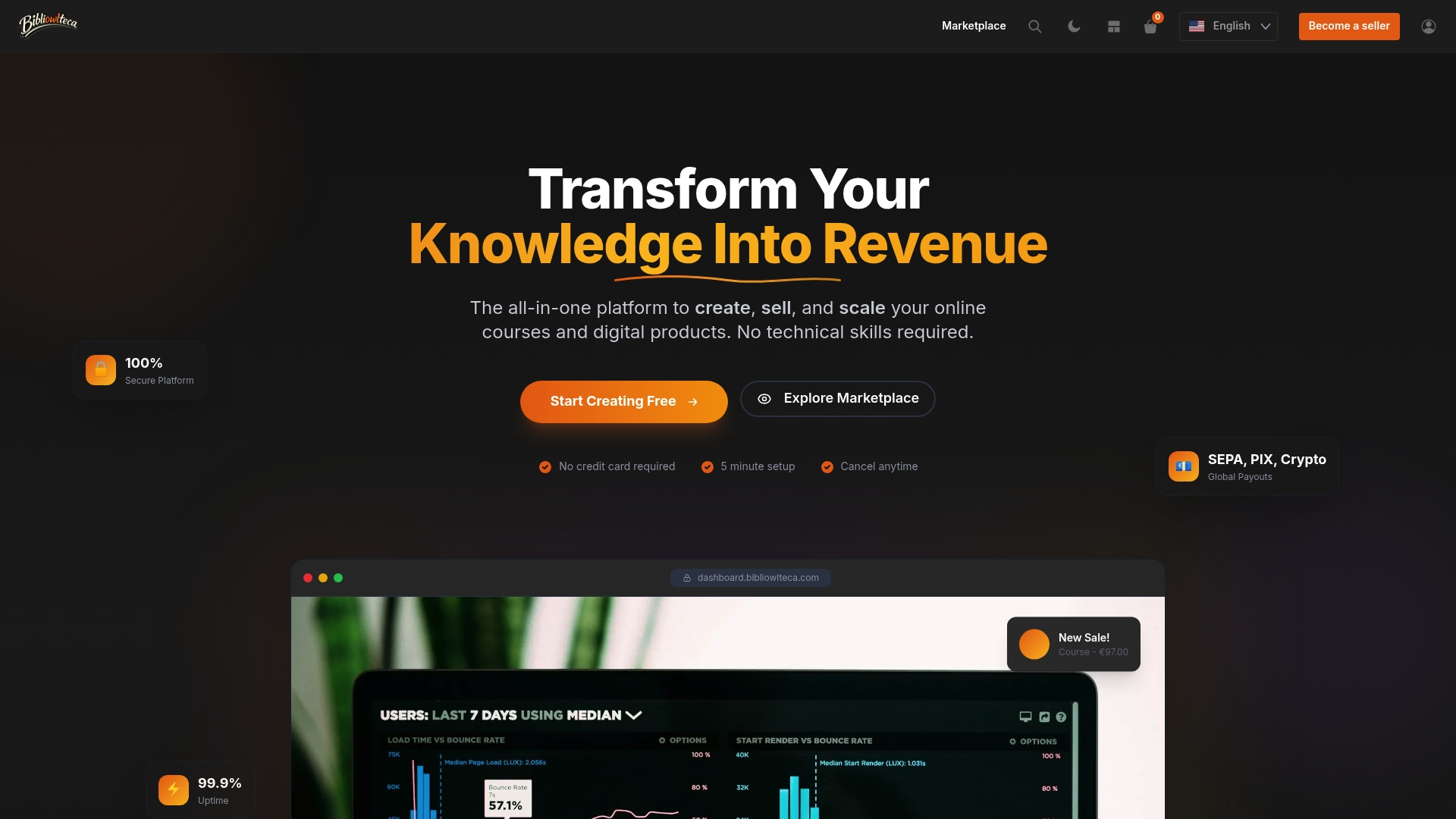
BibliOWLteca is built specifically for creators and educators who want to move beyond marketplaces and own their customer relationships. With built-in tools for digital delivery, payment processing in multiple currencies, and automated tax compliance, the platform removes the technical friction that slows most creators down. Whether you are publishing your first e-book, launching a course for an international audience, or building a full catalogue of educational resources, BibliOWLteca gives you the infrastructure to do it properly — without needing a developer or a technical team behind you.
Frequently asked questions
What are the easiest digital products for passive income?
E-books, templates, and online courses are the leading options because ongoing delivery and sales can be automated after the initial creation work is complete.
How much do I need to invest before seeing passive income?
You can start lean with a minimum viable product and invest iteratively as you validate customer interest, rather than over-building before you know what your audience actually wants.
Should I use a marketplace or sell on my own website?
Marketplace distribution offers easy access to buyers but limits your pricing and customer relationship control, whereas selling direct gives you full flexibility and ownership of your audience data.
How can I maintain quality in scalable digital products?
Regular review against educational standards is essential, particularly for AI-generated content. Quality evaluation approaches that check accuracy and rigour at scale are necessary as your catalogue expands.
What is an audience-first launch?
An audience-first launch means building and engaging your target buyers before releasing your digital product, so that you have a ready group of interested customers from the moment you go live.